
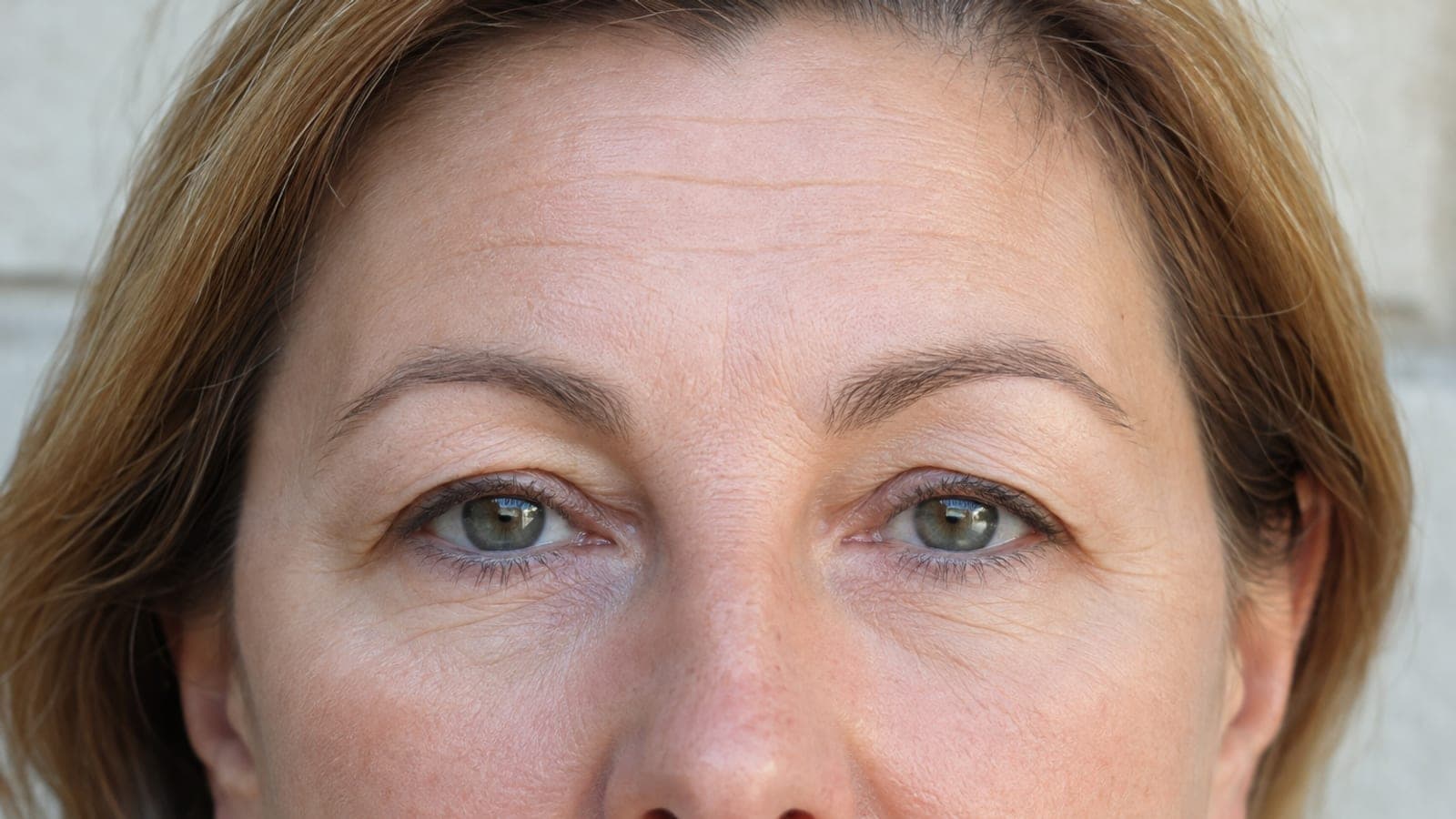
Drooping eyelids come mainly from the slackening of the thinnest skin on the body, around half a millimetre thick, and from a weakened orbital septum. It matters to distinguish a skin overhang from ptosis, that is the drooping of the eyelid itself, which needs proper diagnosis. The sections that follow show what tapes, strips and creams really do, who treatments without a scalpel make sense for, what blepharoplasty involves and how to choose the right moment for it.

Why eyelids droop
The skin of the eyelids is the thinnest on the whole body — about half a millimetre. That is why the effects of passing time show there first: collagen and elastin fibres slacken, the skin stretches and starts to form a fold hanging over the eye. On top of that the orbital septum weakens and the fat that should stay inside the orbit bulges out — this is how "bags" form.
Genes play a big part here: if your parents had heavy eyelids, there is a good chance the problem will appear in you too — sometimes as early as your thirties. Sun, smoking and rubbing your eyes add to it.
An important distinction: a skin overhang (excess skin) is one thing, and drooping of the eyelid itself — so-called ptosis, when the levator muscle fails and the lid covers the pupil — is another. Ptosis requires diagnostic work-up, because it can be a symptom of neurological disease. If the eyelid has dropped quickly, asymmetrically, or is accompanied by double vision — a doctor first, not an aesthetic clinic.
Two situations call not for an appointment next week, but for urgent diagnosis. The first: the eyelid dropped suddenly and along with it came a headache, unequal pupils or double vision — pressure on the oculomotor nerve then has to be ruled out and imaging is needed. The second: the drooping gets worse during the day or after exertion and is milder in the morning — that is the typical picture of myasthenia and a matter for a neurologist. In both cases an aesthetic treatment will not help, it will only delay the diagnosis.
Tapes, strips, creams — what they really do
Honestly, because you ask about this often:
Eyelid tapes and strips lift the fold mechanically — and only while they are stuck on. It is a solution "for the evening": for a wedding, a photo shoot, an important presentation. They will not reduce excess skin, and with daily use they can irritate the thin skin of the eyelids. As camouflage — fine. As treatment — they do not exist.
"Lifting" creams improve hydration and can visually freshen up the eye area. They will not shorten stretched skin — no cosmetic can do that.
Massage and face yoga will not reduce excess skin or fat herniation.
Treatments without a scalpel — who they make sense for
When the problem is at an early stage — the skin is only just losing firmness and the fold is small — treatments that stimulate and tighten the skin, such as fractional microneedle radiofrequency or laser treatments of the eye area, can bring improvement. They work on the quality and firmness of the skin, so their effect is subtle and requires a series.
A separate question that comes up almost every time: will botox lift the eyelid. Injected in the brow area it can raise it slightly and visually open up the eye, but it will not reduce excess skin. It also has a flip side: incorrectly distributed product can temporarily deepen the drooping of the eyelid. This side effect passes on its own once the toxin stops working, but with heavy eyelids the qualification has to be more cautious than usual.
It has to be said plainly, though: when there is a real excess of skin hanging over the eye, no non-invasive treatment will remove it. It can only be cut out. Promising otherwise would be dishonest.

Blepharoplasty — the procedure that removes the cause
Surgical eyelid correction (blepharoplasty) consists of removing excess skin and fat herniation through an incision hidden in the natural fold of the eyelid. A few facts that interest you most:
What is worth knowing before you decide. The most common complaint after eyelid surgery is a dry, gritty feeling in the eye — in large series of operations about one patient in four reports it. It usually passes within a few weeks and moisturising drops are enough, but if you already have dry eye syndrome, tell the surgeon before the procedure — it is one of the main risk factors. Less often there is temporary incomplete closure of the eyelid, swelling of the conjunctiva or, with the lower eyelids, a change in the position of the eyelid margin, which sometimes needs correcting. Complications that threaten sight are very rare, but they do exist: severe, increasing pain in the eye and worsening vision after the procedure is a situation in which you come back to the clinic the same day.
- The anaesthesia is local — you are conscious throughout the procedure, but nothing hurts. There is no general anaesthetic and no hospital stay; you go home the same day.
- The procedure usually takes 2 to 3 hours, depending on the extent (upper eyelids, lower eyelids or both).
- The sutures are usually removed between day 5 and day 7, and most people go back to work right after they come out. Bruising and swelling subside within a few to a dozen or so days.
- The scar hides in the fold of the eyelid and after a few weeks it is practically invisible.
- The effect is long-lasting — once the excess skin has been removed, it usually does not need correcting again for many years. The skin and tissues do go on ageing, though, so in time some patients find they need a correction.
Prices start from 6 000 zł for the upper eyelids and 8 000 zł for the lower ones; correcting both areas during a single procedure — from 12 000 zł.
How to choose the right moment
The best time for the procedure is a period when you can avoid intense exercise and sun for 2–3 weeks — which is why many people choose autumn and winter. It is practical: in autumn and winter it is easier to avoid sun and exertion, and by spring there is no trace of the swelling.
What patients worry about most
The same concerns come up in the consulting room, usually in the same order. They are worth naming outright.
“People will be able to tell I’ve had something done.” The incision follows the natural crease of the upper eyelid or runs just below the lash line, so the scar hides in a natural line and after a few weeks is practically invisible. The aim is not to change your features, only to remove what gives the eyes a tired look.
“I’m afraid of surgery near the eye.” The procedure is performed under local anaesthetic. There is no general anaesthesia and no hospital stay — you go home the same day.
“What if I don’t like the result?” That is exactly why the extent is agreed at the consultation, before the procedure rather than during it. The surgeon assesses how much skin can safely be removed and plans with a margin, so that the eyelid keeps full function and the eyes keep a natural expression.
“How long will I be out of action?” Realistically: a few days with visible swelling and bruising, and a return to work usually right after the stitches come out, between the fifth and seventh day.
When the procedure is not the right answer
Honesty works both ways. Sometimes the right answer is “not yet” or “not with us”.
We do not perform the procedure in cases of blood clotting disorders, uncontrolled diabetes or hypertension, active infection around the eyes, during pregnancy or while breastfeeding. Eye conditions such as dry eye syndrome or glaucoma require separate assessment. A tendency to keloid scarring is a relative contraindication.
Diagnosis first, not an aesthetic clinic, if the eyelid has dropped suddenly and is accompanied by headache, unequal pupils or double vision. Pressure on the oculomotor nerve then has to be ruled out. The same applies when the drooping worsens through the day and is milder in the morning; that picture is typical of myasthenia and belongs with a neurologist. In both situations an aesthetic procedure will not help, and it will delay the diagnosis.
The final decision on suitability is made by the surgeon during the consultation.
Where to start
With a surgical consultation. The surgeon will assess whether the problem is skin, fat or muscle — and whether a procedure is needed at all, because sometimes less is enough. The consultation is also the moment for all your questions: about scars, recovery and the realistic result in your case.
At the Dr Kuschill MEDESTETIS clinics the procedure is performed by a plastic surgeon — in Krakow and Warsaw. You will find the details of the procedure here.
W naszych klinikach
What we can do about it
Zabiegi
- Blepharoplasty – upper and lower eyelid surgeryBlepharoplasty, i.e. surgical plastic surgery of the upper and lower eyelids, permanently removes excess skin and fat herniations, rejuvenating and smoothing the eye area.
- Brow LiftA brow lift is a surgical procedure that raises drooping eyebrows, especially in the outer portion, opening up the gaze and refreshing the upper face.
- PDO Threads – Skin Lifting and BiorevitalizationPDO threads (polydioxanone) tighten and lift the skin while stimulating collagen production — a lifting without a scalpel with an effect visible right away and building over time.
Nie wiesz, który zabieg będzie właściwy? Surgical consultation — dobierzemy metodę do Twojej skóry.
Sources
- Blepharoptosis (Ptosis): Classification, Evaluation, and Surgical Management — StatPearls.
- Dry eye symptoms and chemosis following blepharoplasty: a 10-year retrospective review of 892 cases in a single-surgeon series — PubMed.
- Upper Eyelid Blepharoplasty: Surgical Techniques and Results-Systematic Review and Meta-analysis — PubMed.
- Safety and Complications in Lower Eyelid Blepharoplasty: A Systematic Review — PMC.
- Botulinum toxin type A for facial wrinkles — Cochrane.
Last updated: 14 sierpnia 2026