Treatment
Surgical removal of skin lesions
Surgical removal of skin lesions is scalpel excision of the lesion with the option of histopathological examination, providing oncological safety and allowing care for an aesthetic scar appearance.
At a glance
Duration
20–45 min
Anaesthesia
Yes (local)
Back to everyday life
Usually the same day
Results visible
After healing and suture removal
Recommended series
Single session
This treatment helps with
Where we perform this treatment
MEDESTETIS Klinika Dr Kuschill & Dr Grodecka
Garncarska 8, Kraków
Performed by
What the treatment involves
Surgical removal of skin lesions involves excising the lesion with a scalpel under local anesthesia and then closing the wound with precise sutures. The most important advantage of this method is the ability to send the excised lesion for histopathological examination, i.e. assessment under a microscope.
Histopathological examination makes it possible to unambiguously determine the nature of the lesion and verify it oncologically – to rule out or confirm a neoplastic process. For this reason, surgical excision is the method of choice for suspicious lesions, lesions that change over time, and wherever diagnostic certainty is important.
The procedure is performed by a surgeon after a consultation and qualification. We care not only about the complete removal of the lesion, but also about an aesthetic scar result – we make the incision along the skin's tension lines and close the wound with a technique that minimizes its visibility.
Indications
Surgical excision of a skin lesion is indicated in cases such as:
- moles (nevi) and pigmented lesions that change shape, color, or size, or that bleed
- lesions suspicious for cancer that require histopathological verification
- moles exposed to constant irritation (by a belt, strap, or collar)
- keloids and hypertrophic scars — after assessing the risk of recurrence
- larger fibromas, sebaceous cysts, lipomas, and cysts
- lesions recurring after previous non-surgical treatment
- lesions that the patient wants removed with diagnostic certainty as to their nature
How the treatment works
After a consultation and assessment of the lesion, with dermatoscopy if needed, the surgeon plans the extent of the excision and administers local anesthesia. Thanks to this, you remain conscious throughout and feel no pain.
The surgeon excises the lesion with a scalpel along with a margin of healthy tissue chosen according to its nature, then closes the wound with sutures, taking care of an aesthetic scar line. The excised lesion – if there are indications for it – is sent for histopathological examination. The whole procedure usually takes from 20 to 45 minutes, depending on the size and location of the lesion. We discuss the examination result at a follow-up visit.
Results
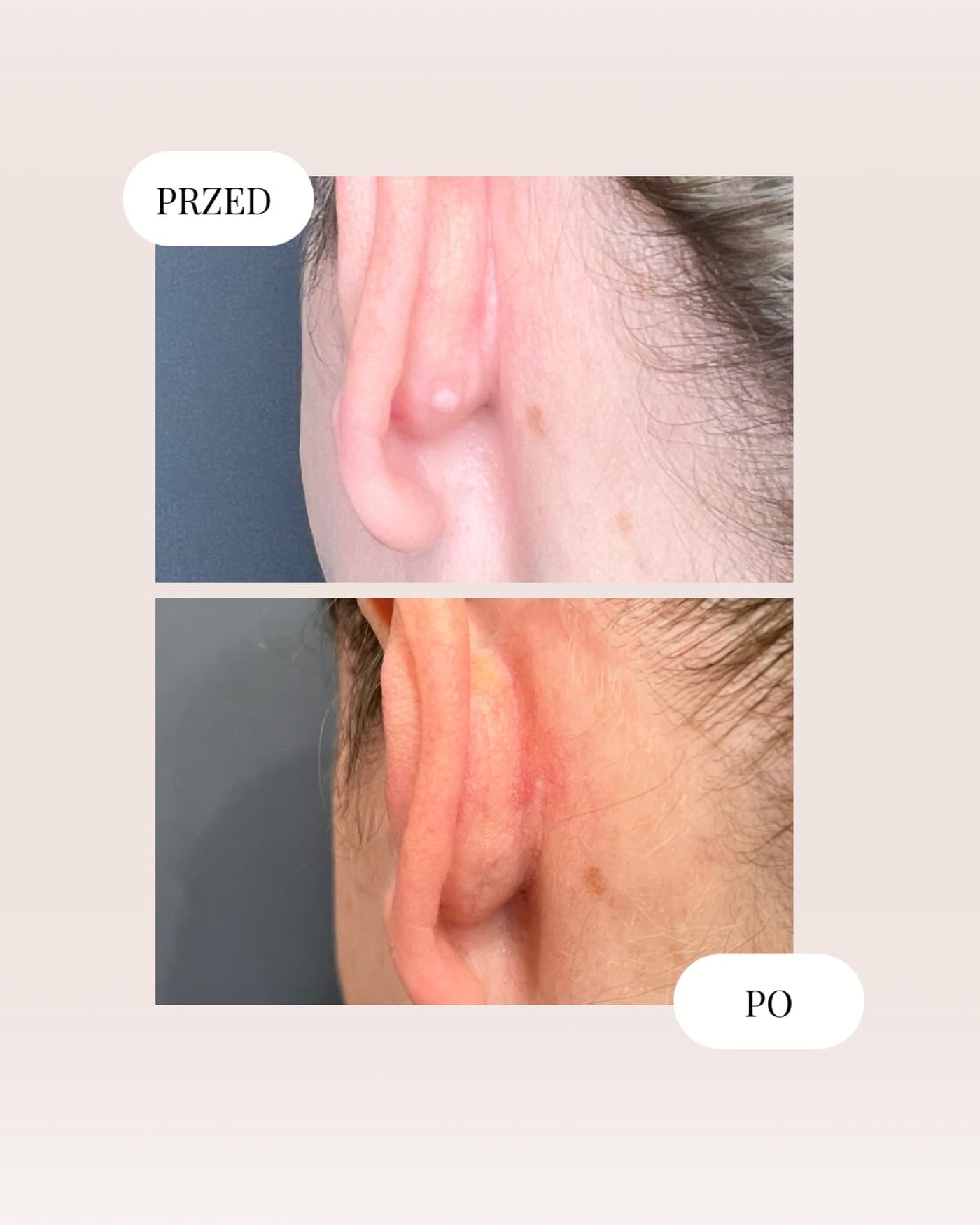
The lesion is removed in its entirety, and histopathological examination provides certainty as to its nature and oncological safety. After the procedure, a suture remains at the excision site, which we remove usually after 7–14 days, depending on the area of the body.
The scar fades over time and becomes less visible. Its final appearance depends on the location, the size of the lesion, and your skin's individual characteristics, and proper care significantly improves the aesthetic result.
Aftercare
Proper care of the wound and sutures determines the aesthetics of the scar and reduces the risk of complications. Remember to:
- keep the wound clean and dry as instructed by the physician
- change the dressing and cleanse the wound with an antiseptic as instructed
- avoid wetting the wound – the swimming pool, sauna, and long baths until healed
- limit physical exertion and tension on the skin around the sutures
- come in to have the sutures removed on the scheduled date (usually 7–14 days)
- protect the scar from the sun and use a high-SPF sunscreen for many weeks
- come in to collect and discuss the histopathological examination result
Contraindications
Contraindications and situations requiring caution include:
- blood clotting disorders or taking anticoagulants (requires assessment and adjustment)
- an active infection of the skin or tissues at the planned treatment site
- poorly controlled chronic diseases (diabetes, hypertension)
- poorly controlled wound-healing disorders
- a tendency to form keloids and hypertrophic scars (relative contraindication)
- pregnancy and breastfeeding (requires individual assessment)
- allergy to local anesthetic agents
The final qualification is carried out by the surgeon during the consultation.
Pricing
Available in: Kraków
Surgical removal of skin lesions
| Wariant | Zabieg pojedynczy |
|---|---|
| Scar treatment | od 1000 zł |
| Lesion excision with plastic repair | od 1000 zł |
| Lesion excision from the face | od 2000 zł |
| Lesion excision from the lip | od 2500 zł |
| Lesion removal from the eyelid | od 2500 zł |
The final cost is agreed during the consultation, once your plan is set.
Frequently asked questions
How does surgical removal of lesions differ from non-surgical methods?+
Surgical excision removes the lesion in its entirety and allows histopathological examination, i.e. oncological verification. Non-surgical methods, such as cryosurgery, do not provide material for such an examination and are used only for lesions that are reliably benign.
Is every excised lesion examined histopathologically?+
We perform histopathological examination whenever there are indications for it – especially with suspicious or changing lesions. This is a standard of oncological safety. The scope of the examination is determined by the surgeon.
Is the procedure painful?+
The procedure is performed under local anesthesia, so you feel no pain. Once it wears off, mild discomfort may appear, which is relieved by typical painkillers.
When are the sutures removed?+
Sutures are usually removed between day 7 and day 14, depending on the area of the body. On the face, sutures are removed earlier, and in areas with greater skin tension – somewhat later.
What will the scar look like?+
We make the incision along the skin's tension lines and close the wound with precise sutures so that the scar is as inconspicuous as possible. Its final appearance depends on the location, the size of the lesion, and your skin's individual features.
When will I get the examination result?+
The histopathological result is usually ready within several days. We discuss it with you at a follow-up visit and, if needed, determine the further course of action.
How much does surgical removal of moles cost?+
Excision of a lesion costs from 1,000 zł, lesions on the face from 2,000 zł, and on the lip or eyelid from 2,500 zł. The price includes the procedure under local anesthesia; you will receive an exact quote — including any histopathological examination — at the consultation.
Laser or surgical removal of moles — which to choose?+
Pigmented lesions (moles, nevi) are safer to excise surgically, because only then is material left for histopathological examination — a laser vaporizes the tissue irreversibly. We reserve the laser and other non-surgical methods for lesions that the physician has assessed as unambiguously benign. The choice of method is always preceded by a medical assessment.
Do you remove sebaceous cysts and lipomas?+
Yes — surgically, under local anesthesia. A sebaceous cyst is removed together with its capsule, which minimizes the risk of recurrence; lipomas are enucleated in their entirety. The excised lesion can be sent for histopathological examination.