
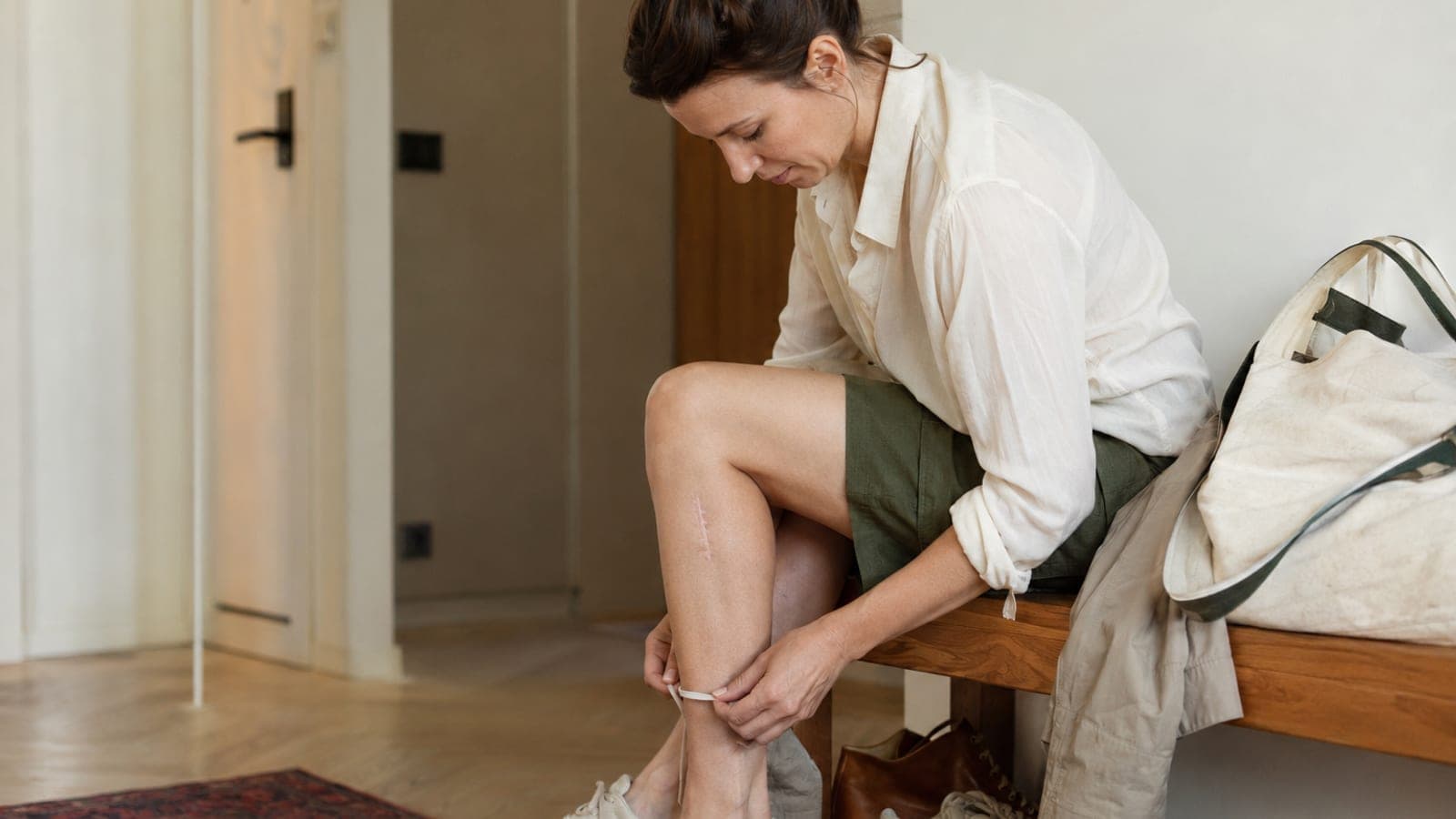
A scar is not damaged skin that will regenerate but permanent replacement tissue, which is why a mature scar will not disappear because of a cream. One thing works on a fresh scar and another on an old one, and some popular methods do not work at all. Here we set out what gives a poor effect or none, what works for particular types of scar, when it is best to start and how much it costs.

Why a scar does not disappear on its own
A scar is not "damaged skin" that will regenerate. It is replacement tissue — at the site of the injury the body lays down collagen fibres quickly and any old how, because its priority is closing the wound, not aesthetics. The fibres run parallel instead of in their natural mesh, hair follicles and glands are missing, and sometimes pigment is too.
This structure is permanent. The skin replaces the cells of the epidermis, but it will not rebuild the deep architecture of a scar on its own. That is why a mature scar will not disappear because of a cream — no product applied to the surface will rearrange the collagen fibres in the dermis.
What works poorly or not at all
Scar ointments and gels make sense mainly in the first months, while the scar is still maturing. They moisturise, lubricate and can improve its elasticity. On a scar that is several years old they act only superficially.
Silicone patches and gels are the exception: in the guidelines they are the first-choice approach — both in preventing scars and in treating hypertrophic ones. There is one condition: they have to be worn for a dozen or so hours a day for at least two to three months. Two weeks of irregular application will change nothing, and that is the most common reason patients decide silicone does not work. An old, retracted scar, however, is something silicone will not fill in.
Home remedies — onion, lemon, apple cider vinegar — have no proven effect, and acids can irritate the area around the scar and make it look worse.
What works — depending on the type of scar
There is no single method for all scars, because "scar" covers several different problems.
Atrophic and post-acne scars — depressions in the skin, most often after acne or chickenpox. Here well-documented results come from the fractional laser: it creates micro-injuries in the skin that force it to remodel and produce new collagen. The depressions gradually become shallower. The same mechanism underlies fractional microneedle radiofrequency and microneedling — in comparative studies the results of these methods are similar, so the choice is decided by the type of scars and the skin type, not by the technology itself. We write more about this group of scars in a separate article: Post-acne scars — how to remove them.
Post-surgical and post-traumatic scars — including after a caesarean section. If the problem is colour and texture, a series of fractional laser treatments works. If the scar is wide, hypertrophic or badly aligned with the lines of the skin, the solution can be surgical scar revision — excision and precise re-suturing. Which route makes sense is decided by the doctor after examining the scar.
Keloids — scars that grow beyond the borders of the original wound. They are a separate category: they require caution, because clumsy irritation can make them larger. Medical assessment is mandatory here, and treatment often combines several methods — the starting point is usually injections given directly into the scar, in a series every few weeks. Importantly: excising a keloid on its own, without additional treatment, ends in a recurrence larger than the original scar in a large proportion of patients, which is why surgery is not the first step here.
Stretch marks — technically they are scars too, which is why they respond to the same treatments. They respond best to the laser in the early, red phase; white, mature stretch marks cannot be removed, and the improvement is usually moderate — realistically we are talking about making them shallower and evening them out with the surrounding skin, not about them disappearing.
When to start — the earlier, the easier
A scar matures over several months to about a year. During that time it is most responsive to treatment — and that is exactly when prevention (silicone, sun protection, lubrication) gives the most.
With laser treatments, however, there is no need to wait for the scar to grow "old", nor to worry about it: the fractional laser also improves scars that are many years old. The difference is that an old scar usually needs a longer series.
One practical note: after laser treatments the skin has to be protected from the sun, which is why the best time to start a series is autumn and winter.
And one more thing about expectations, because satisfaction with the treatment depends on them. The aim of a series of treatments is to make the scar shallower and to even it out with the surrounding skin, not to make it disappear — no method will restore the normal structure of the skin within a scar. A realistic plan is a series of several treatments and an assessment of the result after a few months.
How much it costs
Fractional laser treatments start from 600 zł per session; a series of 3–6 treatments is usually needed. Surgical treatment of scars is priced individually, from 1000 zł. An exact quote is preceded by a consultation — the doctor assesses the type of scar and selects the method.

Where to start
By showing the scar to a specialist. The assessment takes a few minutes and settles the most important question: whether it is an atrophic scar, a hypertrophic scar or a keloid — because everything that follows depends on that. Testing one ointment after another on your own can take years and settles nothing.
At the Dr Kuschill MEDESTETIS clinics in Krakow and Warsaw a doctor will assess the scar and the treatments are performed by a trained team — you will find the details of laser removal of scars and stretch marks here.
W naszych klinikach
What we can do about it
Zabiegi
- Laser removal of scars and stretch marksLaser removal of scars and stretch marks smooths post-acne, post-surgical scars and post-pregnancy stretch marks. The fractional laser stimulates the skin to rebuild collagen, and the qualification is carried out by a cosmetologist.
- Fractional CO2 laserThe fractional CO2 laser is one of the most effective skin renewal treatments — it deeply remodels collagen, smooths scars, stretch marks and wrinkles.
- Fractional Microneedling RadiofrequencyFractional microneedling radiofrequency combines microneedling with radio waves, firming the skin and reducing wrinkles, scars and stretch marks.
Nie wiesz, który zabieg będzie właściwy? Cosmetology Consultation — dobierzemy metodę do Twojej skóry.
Sources
- Management of scars: updated practical guidelines and use of silicones — PubMed.
- Triamcinolone acetonide intralesional injection for the treatment of keloid scars: patient selection and perspectives — PubMed.
- Fractional Radiofrequency Microneedling as a Monotherapy in Acne Scar Management: A Systematic Review of Current Evidence — PubMed.
- A Systematic Review on Treatment Outcomes of Striae — PubMed.
Last updated: 14 sierpnia 2026