
Melasma (chloasma) — why the usual methods for pigmentation marks fail here
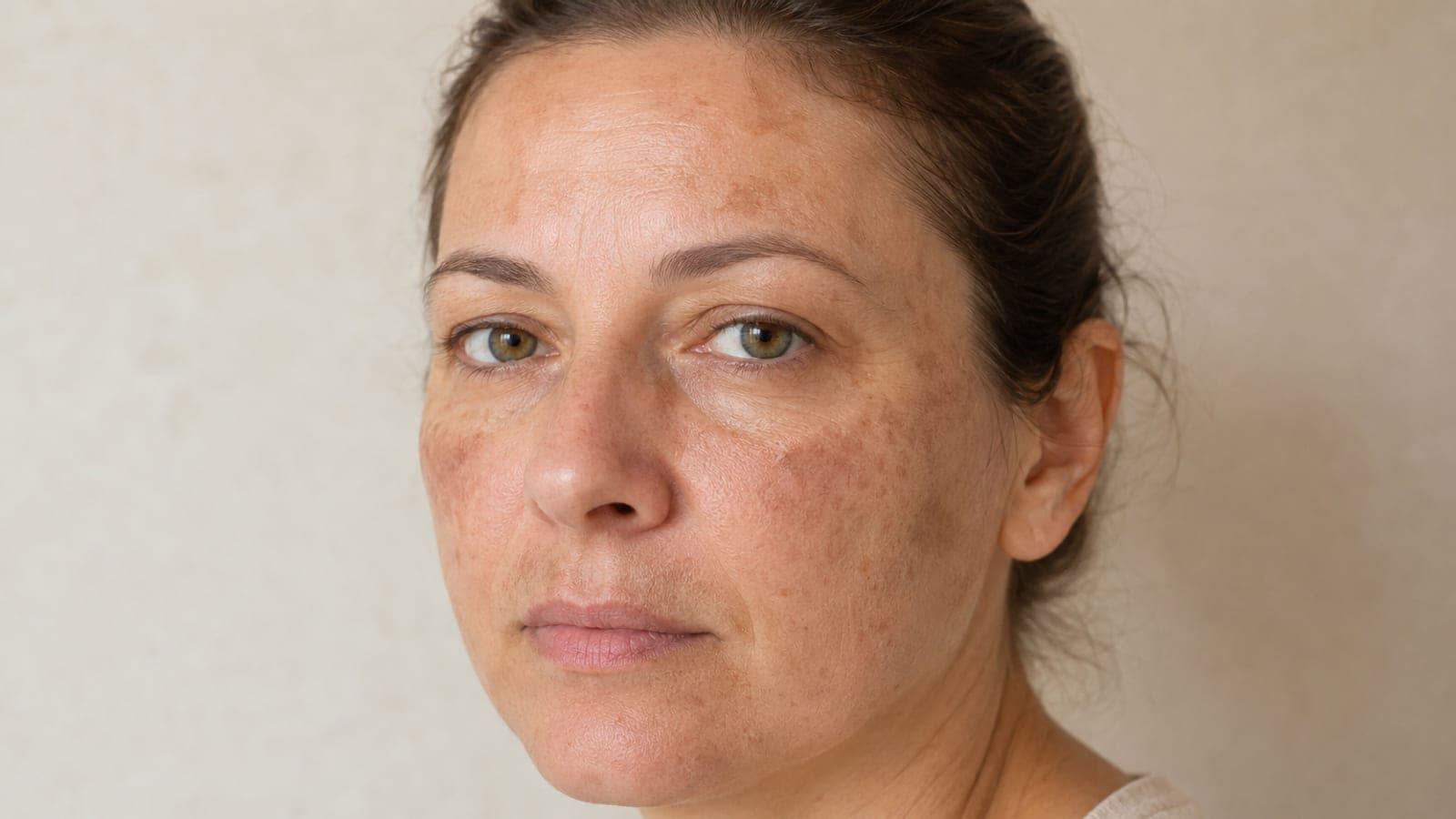
Melasma is not “ordinary pigmentation” but a chronic disorder of melanocyte function that also involves the dermis. It shows as brown, diffuse and symmetrical patches on the cheeks, forehead or above the upper lip, which darken in summer and only fade in winter. That is why it comes back after the holidays and why it is treated differently. Below we explain how it differs from ordinary pigmentation, why a high-street cream and a single treatment will not be enough, and what really works.
How melasma differs from ordinary pigmentation marks
A typical pigmentation mark — after the sun, after acne, after an injury — is a single patch in the place where the skin went through a specific event. It has a clear cause and usually responds well to brightening treatments.
Melasma is something else: a chronic disorder of the work of the melanocytes, that is, of the cells that produce pigment — and not only of them. The changes also involve the dermis: a damaged border between the epidermis and the dermis, and an expanded network of fine vessels. That is largely why quietening the melanocytes alone does not close the matter, and why the patches have a tendency to come back. The characteristic picture is extensive, symmetrical patches on the cheeks, the forehead, the nose and above the upper lip. Two factors drive it:
- hormones — which is why it often appears in pregnancy (the "pregnancy mask"), with hormonal contraception or with hormone therapy for the menopause,
- UV radiation — every exposure to the sun stimulates the overactive melanocytes anew. A walk on a sunny day without sunscreen is enough.
That is why melasma "comes back after the holidays" and why it mainly affects women between the ages of 20 and 50.
If the patches appeared during pregnancy, or if you are breastfeeding — we will wait with treatment. Some lightening products are contraindicated at that time, and in many women the discoloration fades on its own after childbirth. During this period we do one thing, but consistently: we protect the skin from the sun and from visible light. We return to therapy when it is safe and has a chance of giving a lasting result.

Why a drugstore cream and a single treatment will not be enough
Brightening cosmetics act on the surface, while the problem of melasma sits in the overactivity of the pigment cells — without calming that overactivity the patches rebuild themselves from within.
There is a second trap too: aggressive, one-off treatments can make melasma worse. Strong irritation of the skin can stimulate the melanocytes even more — the result is sometimes post-inflammatory pigmentation at the treated site. That is why an experienced doctor does not start treating chloasma with a powerful laser.
What really works
In our clinics the basis of treatment is depigmentation therapy: a protocol spread over time that combines an in-office treatment (a mask with a high concentration of ingredients that inhibit pigment production) with several months of home care that maintains the effect. It works on the cause — it calms the overactive melanocytes — and not only exfoliates what is visible.
In our clinics we run it as part of depigmentation therapy; the doctor decides on eligibility and the plan. The therapy costs 1950 zł.
The second, non-negotiable element is photoprotection: an SPF 50+ filter every day, all year round, including in winter and on cloudy days. Without that, every depigmentation therapy is work that can be burned away in one go — literally.
The best moment to start is autumn and winter — less sun means a calmer course of the therapy and a lower risk of recurrence while it is under way.
And one clarification that makes a difference in melasma. A high SPF alone is not enough, because it describes protection against UVB radiation, while the patches are also stimulated by visible light. That is why we recommend tinted sunscreens containing iron oxides — it is the pigment that blocks visible light. In studies, a sunscreen protecting against UV and visible light gave a clearly better lightening effect than one protecting against UV alone. We will choose the specific product to suit your skin tone at the consultation.

Melasma is a marathon, not a sprint — and we say so honestly
Melasma cannot be "removed once and for all" — the tendency remains. What can be done is to bring the skin to an even tone and maintain that state, by combining the therapy, home care and consistent sun protection. Patients who know this rule from the start are satisfied with the results; the disappointed ones are those who were promised a miracle after a single treatment.
First step: show the patches to a doctor. Telling melasma apart from other pigmentation changes — including those that require diagnostic work-up — takes a few minutes, and it decides the whole path of treatment.
W naszych klinikach
What we can do about it
Zabiegi
- Depigmentation TherapyProfessional depigmentation therapy effectively lightens hyperpigmentation, including melasma (chloasma).
- Laser treatment of pigmentation and rednessLaser treatment of pigmentation and redness is a safe way to even out skin tone and reduce spots, redness and symptoms of rosacea.
Nie wiesz, który zabieg będzie właściwy? Cosmetology Consultation — dobierzemy metodę do Twojej skóry.
Sources
- Melasma — StatPearls, NCBI Bookshelf.
- An Update on New and Existing Treatments for the Management of Melasma — PubMed.
- Near-visible light and UV photoprotection in the treatment of melasma: a double-blind randomized trial — PubMed.
- Self-applied topical interventions for melasma: a systematic review and meta-analysis of data from randomized, investigator-blinded clinical trials — PubMed.
- Tranexamic Acid in the Treatment of Melasma: A Review of the Literature — PubMed.
Last updated: 14 sierpnia 2026