
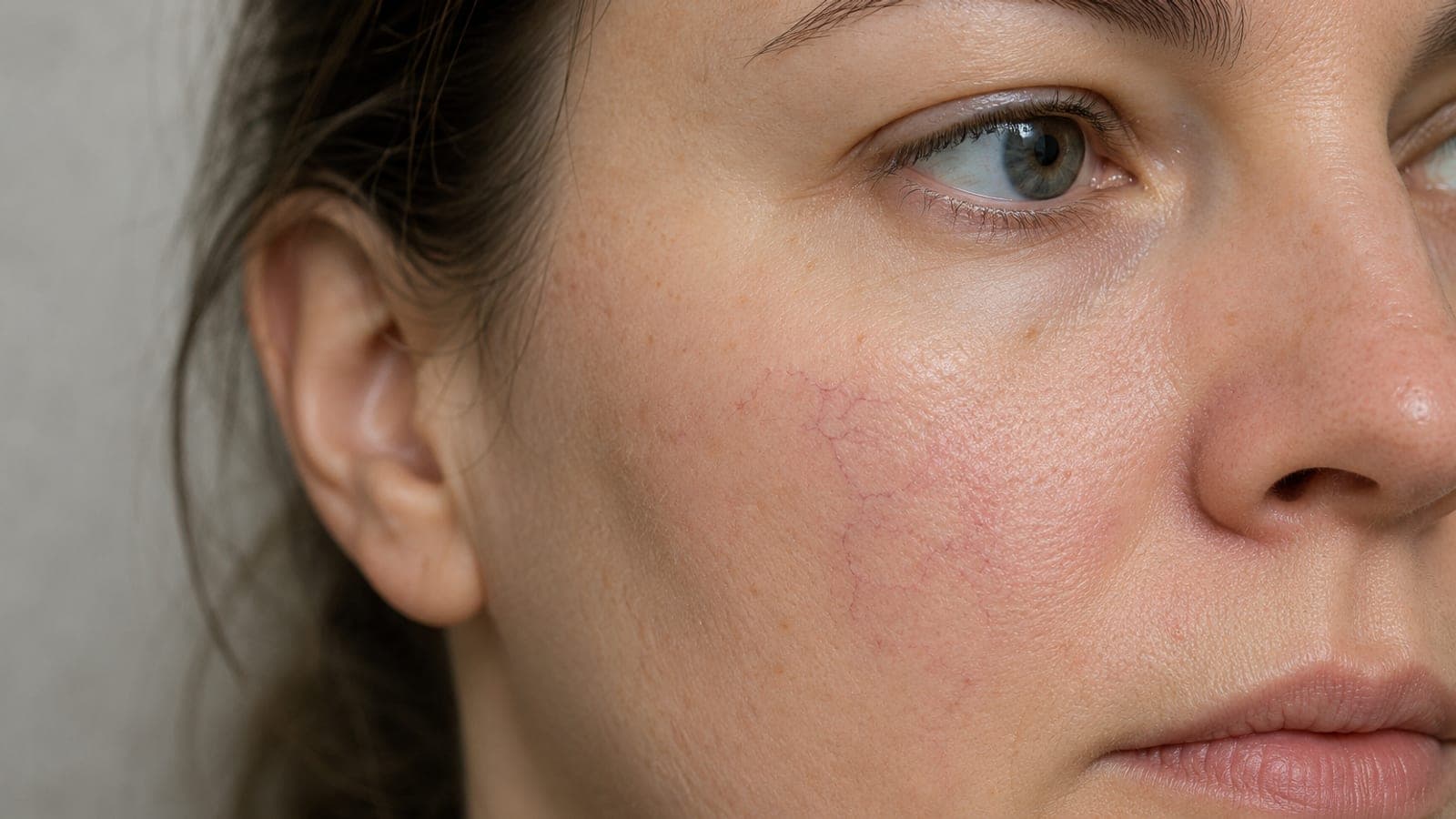
Broken capillaries are not a matter of age and do not affect the face alone: people in their twenties complain about them too, and spider veins also appear on the legs and décolletage. The most common cause is hereditary, with hormones and lifestyle adding to it. Further on: how capillaries on the face and on the legs are treated, why a different device is chosen for each of these areas, where sclerotherapy fits in and what to do so that the result lasts.
Culprit number one lives in your genes
The most common cause is banal and entirely beyond your control. You inherit it.
This has been counted best for varicose veins of the lower limbs. When both parents were affected, the risk in the child reaches 90%; when one was — it is about 25% in sons and 62% in daughters. For capillaries on the face there are no such figures, but the family tendency is just as clearly visible in the clinic.
So if your mother complained for years about spider veins on her legs and you are getting them in the same place, it is no coincidence.
Hormones can weaken the vessel wall
The second group of causes is hormonal disorders. From many studies we know that they can make blood vessels more fragile — and a fragile vessel breaks more easily.
That is why the problem so often shows up in pregnancy or at times when the hormone balance is unsettled anyway.

The third cause: a lifestyle nobody suspects
And here it gets uncomfortable, because this group is one you do influence.
The lifestyle-related causes affect more and more people and you can see it at the office — there are more patients looking for a way to deal with broken capillaries every year.
The risk is higher for:
- smokers,
- people who are overweight,
- people who lead a sedentary lifestyle,
- pregnant women.
The good news is that we know why capillaries break, and we know what to do to make them disappear. The answer, however, is not aesthetic medicine alone. Without changes in everyday habits the effect will not last long.
Let us add two more to the list of causes, the ones patients think of least often. The first is the sun — telangiectasias on the face are one of the classic signs of photoageing, and over the years every holiday without sunscreen adds to them. The second is rosacea: if the capillaries come with recurring redness, a burning sensation and papules, this is not a vascular problem alone and it calls for dermatological treatment, not only a procedure.
The treatment is only half the success
This is the sentence we repeat to patients most often.
After a course of treatment, vascular skin needs careful protection. Not because the treatment is delicate — but because the tendency for capillaries to break does not disappear along with the capillary.
What is worth avoiding:
- extreme temperatures,
- long periods in cold air,
- moving abruptly from freezing surroundings into overheated rooms,
- very spicy food,
- alcohol.
When you go outside, use protective creams enriched with sunscreen filters. In the evening reach for soothing cosmetics containing ingredients that strengthen the walls of blood vessels — rutin, horse chestnut extract or vitamin C.
Thanks to this the treatment works more effectively, and the risk of further spider veins appearing is lower.
Capillaries on the legs: prevention first
On the legs the rule is simple — prevention is easier than treatment.
The basis is wearing preventive anti-varicose tights, stockings or knee-highs. Especially when you are in the risk group for varicose veins, so above all in pregnancy.
Besides that, three habits worth giving up:
- standing for long periods,
- sitting with your legs crossed,
- wearing tight leggings and trousers.
One thing before closing capillaries on the legs. If, apart from the spider veins, you are bothered by a feeling of heaviness in your legs, swelling around the ankles towards evening, or you can see clear varicose veins, a Doppler ultrasound of the veins is needed first. The spider veins may then be only a symptom of venous insufficiency in deeper vessels — and if we do not deal with the cause, the closed capillaries will come back. We then start with phlebological treatment and deal with the aesthetics at the end.
How broken capillaries are treated
The method depends on where the lesions are and how extensive they are. The doctor decides after examining the skin — a web of capillaries on the cheek is approached differently than a single large vessel on the calf.
What we do in our clinics:
- Laser closing of vessels (Nd:YAG laser) — The laser beam hits the chosen area precisely and causes the dilated vessel to contract and close rapidly · Large vascular lesions on the face and body, including capillaries on the legs. The handpiece has an epidermal cooling system, which reduces pain, protects against burns and increases the comfort of the treatment.
- Light therapy (narrowband pulsed light 500–600 nm) — Controlled thermal damage to the cells in which hemoglobin has accumulated · Telangiectasias on the face, redness, hemangiomas, rosacea, cherry angiomas. Also used for discoloration.
- Complete — redness reduction — An original, multi-stage procedure for vascular skin: laser therapy, tropocollagen and soothing LED phototherapy · People with persistent redness and a weakened protective skin barrier who need an organized plan rather than a single treatment.
You have to prepare for the treatment, and the patient decides half of the success. For about four weeks before the treatment and after it we do not sunbathe and do not use self-tanner — on tanned skin the risk of a burn and of discoloration rises. Tell the doctor about all your medications too: some of them make the skin sensitive to light. If you get cold sores, mention it before a treatment in the lip area.
Why the laser works well on the legs
Thanks to modern technology the treatment is almost painless, very short and requires no recovery period. Single capillaries on the face can often be closed in one session. Capillaries on the legs respond more slowly — there a series of three to five treatments is usually needed, which is why we plan a series from the outset rather than a single visit.
Why light is used more often on the face
Telangiectasias on the face — those dilated blood vessels visible under the skin — respond very well to narrowband pulsed light in the range of 500–600 nm.
This is a light beam that is well tolerated by the skin, and the effects of the therapy appear in a short time. Pulsed light works through heat, however, so with incorrectly chosen settings or on tanned skin it can lead to a burn, blisters or temporary discoloration — which is why the settings are chosen individually, after assessing the skin tone. Using a series of three filters that concentrate the light in a narrower range makes it possible to achieve a noticeable reduction of the lesions.
In some cases one treatment is enough. Diffuse redness and couperose skin usually call for a series — from two to six treatments at intervals of 3–5 weeks. The decision is always made by the doctor.
And what about sclerotherapy?
With capillaries on the legs this word sometimes comes up, so it is worth explaining what it means.
Sclerotherapy consists in injecting a preparation that obliterates blood vessels into their lumen, through punctures with a very fine needle. After 4–6 weeks the vessel closes up, and for 2 weeks after the procedure it is advisable to wear compression tights or stockings.
This is a method within the treatment of vascular lesions of the lower limbs and it requires medical qualification. If the doctor decides that it is the best solution in your case, they will indicate where to have it done.

Finally: it is not your fault
Since you have made it this far, one thing is worth emphasizing.
In most cases broken capillaries do not come from neglect. They come from genes, hormones and the structure of the vessels, which you have no influence over. No cream will reverse them — but some of the capillaries on the face can be prevented by protecting the skin from the sun consistently.
What you can do is close them — effectively, quickly and with practically no recovery. And then make sure that new ones appear as rarely as possible.
The first step is showing your skin to a doctor. The assessment takes about a quarter of an hour and it is immediately clear which method makes sense in your case.
We close visible capillaries with the Nd:YAG laser — with the same handpiece on the legs as well. If, apart from the capillaries, persistent redness bothers you, take a look at our multi-stage procedure Complete — redness reduction.
W naszych klinikach
What we can do about it
Zabiegi
- Laser closure of blood vesselsLaser closure of blood vessels with the Nd:YAG 1064 nm laser effectively removes dilated vessels, erythema and vascular lesions on the face and legs.
- Complete – Redness ReductionComplete is MEDESTETIS's signature multi-stage redness reduction procedure for vascular skin that calms redness, strengthens the skin barrier and improves comfort by combining laser therapy, tropocollagen and LED phototherapy.
Nie wiesz, który zabieg będzie właściwy? Cosmetology Consultation — dobierzemy metodę do Twojej skóry.
Sources
- Nd:YAG 1064 nm laser in the treatment of facial and leg telangiectasias — PubMed.
- Treatment of lower extremity telangiectasias in women by foam sclerotherapy vs. Nd:YAG laser: a prospective, comparative, randomized, open-label trial — PubMed.
- Light-Based Devices for the Treatment of Facial Erythema and Telangiectasia — PMC.
- Intense Pulsed Light (IPL) Therapy — StatPearls.
- Importance of the familial factor in varicose disease. Clinical study of 134 families — PubMed.
- Sunscreens and Photoaging: A Review of Current Literature — PMC.
Last updated: 14 sierpnia 2026