
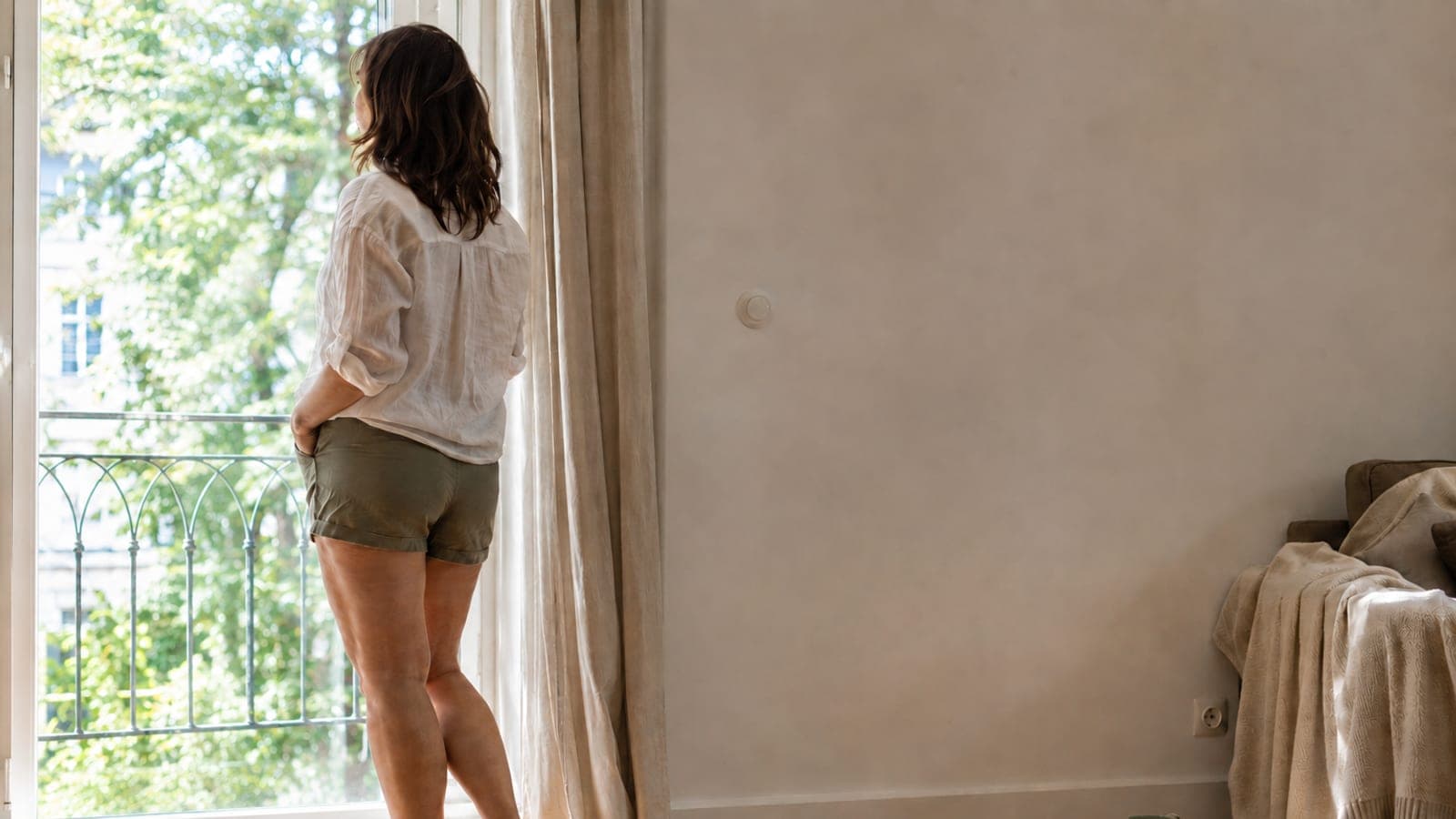
Up to 90% of women over 25 have cellulite, so it is not a matter of lacking discipline. It is an uneven distribution of fat tissue together with changes in the subcutaneous connective tissue. It is not removed once and for all: it is a condition you reduce, smooth out and keep under control. Below: where orange-peel skin comes from, what makes it worse, where to start, what role movement plays and which treatments we use in the clinic.

What cellulite actually is
It is an abnormal distribution of fatty tissue together with pathological changes within the subcutaneous connective tissue.
It appears most often on the thighs, especially at the back. It does not spare the buttocks, the abdomen and the arms either.
It affects women all over the world. Asian women complain about it somewhat less often, but they too struggle with the orange-peel effect.
Where “orange-peel skin” comes from
The answer lies in the structure of the subcutaneous tissue.
Subcutaneous fatty tissue is divided by fibrous septa. In women who develop cellulite, the septa between the lobules run perpendicular to the skin — there are few transverse ones.
When the pressure inside a lobule rises (with excessive fat or with compression), the lobule bulges upwards. On the surface of the skin this shows as unevenness.
That is why cellulite does not translate simply into weight. What decides is the architecture of the tissue, not the number on the scales.
One more thing is worth adding, because it explains why this is not a matter of discipline. In men the fibrous septa run obliquely, at an angle of about 45 degrees, forming a dense mesh; in women they run perpendicular to the skin and there are fewer of them, so the fat lobules are larger and less well supported. It is an anatomical difference we are born with — which is why cellulite affects 80 to 98 per cent of women after puberty and practically does not occur in healthy men.
What makes it worse
A lack of physical activity is only one of the causes. Besides it, what counts is:
- hormones, mainly oestrogens,
- genetic predisposition,
- a diet rich in sugars and unhealthy fats.
Three of these factors are beyond your control, or only partly within it. That matters, so that cellulite is not treated as a personal failure.
Where to begin
When I start working on cellulite with a patient, I always give warning: the results are not immediate.
The starting point is a review of the diet and a change of a few habits.
Salt. It is worth reducing the amount and replacing it with herb mixes — basil, marjoram, coriander, dried parsley.
Highly processed, calorie-dense food. It causes harmful substances to be deposited in the fat cells.
Spirits. They are not only high in calories — they also reduce the ability of fatty tissue to break fat down naturally.
Cigarettes. Here I am uncompromising. Smoking causes additional oxygen deficiency in the area affected by cellulite and increases the production of free radicals.
Then there is the rhythm of the day. Fixed mealtimes help you stick to a diet, although at the same calorie intake the number of meals in a day changes little in itself. The menu should include ingredients that speed up the metabolism — fish, low-fat cheeses, pulses.
When the metabolism starts to work differently, it needs help. Two litres of still, low-sodium water a day help to keep the tissues properly hydrated and to limit the water retention caused by salt.

Movement: muscles as scaffolding
Diet can achieve a great deal, but combined with regular physical activity the results are better and come sooner.
I encourage patients to consult a personal trainer. After an initial interview they will put together an individual exercise plan.
The mechanism is simple: well-developed muscles are solid scaffolding for the skin. The skin becomes taut and smooth — despite the temporary slackening that appears after weight loss.
Treatments: what we do in the clinic
When, despite changes in lifestyle, cellulite is still a nuisance, I prepare a treatment-based plan with the patient.
One honest caveat before we get to specifics. The quality of scientific evidence in the treatment of cellulite is generally low — most studies are small and without a comparison group. The best documented are acoustic wave therapy, radiofrequency and injectable preparations that cut through the fibrous septa. This does not mean the other treatments do not work — rather that the effect is to be sought in a series and in combination with a change of lifestyle, not after a single visit.
I stress: a plan, not a single treatment. Only the combination of diet, movement and specialist treatments gives clear results.
LPG endermologie — for water retention
The most popular of the treatments. The method was developed in France in the mid-1980s.
It consists of simultaneously massaging and suctioning the tissue with a special head. It uses electronically controlled rollers and a vacuum, which together act on all layers of the skin.
The treatment improves lymph and blood circulation. This in turn increases lipolysis and reduces water retention. The tissue becomes softer and in some people the skin is also smoother to the touch — in the only randomised trial, an improvement in the appearance of the cellulite itself was recorded in a minority of the treated legs. The effect requires a series and lasts as long as you keep working on your lifestyle.
A study conducted at the Purpan university hospital in Toulouse showed that endermologie stimulates fat-releasing processes in adipose tissue. It was a small study without a control group, which is why we speak of the direction of action rather than of particular percentages.
The treatment can be applied to various parts of the body.
Shockwave therapy — for firmness and unevenness
It uses an acoustic wave and high-frequency energy to induce electrostimulation of the muscles.
The energy penetrates deep into the tissue. The impulses produce vibrations that cause alternating mechanical stretching and relaxation of the connective tissue.
The list of effects is long:
- rebuilding and densifying collagen,
- firming slack skin,
- increasing tone and elasticity,
- improving microcirculation and metabolism in the treated area,
- the formation of new capillaries.
Mesotherapy — acting where the problem is
Good results also come from mesotherapy with a preparation dedicated to cellulite, administered subcutaneously — that is, exactly where the problem is.
The preparation supports circulation in the areas affected by cellulite, which provides better oxygenation of the skin and helps to nourish and regenerate the tissues.
The result is a reduction in tissue swelling, a reduction in circumference of even a few centimetres and smoother skin. The treatment is applied above all to the abdomen, thighs, buttocks and arms.
Important: the treatment is carried out once a week, in a series of 7 to 12 sessions.
Coolshaping cryolipolysis
For reducing stubborn fat we today use Coolshaping cryolipolysis — non-invasive reduction with controlled cold.
Which treatment for what — in brief
- LPG endermologie — Massage with tissue suction, rollers and vacuum · Water retention, softening and smoothing of cellulite · In a series.
- Mesotherapy — A preparation administered subcutaneously, drainage and improved circulation · Swelling, circumference, smoothness of the skin — abdomen, thighs, buttocks, arms · Once a week, 7–12 sessions.
- Coolshaping cryolipolysis — Reduction of fatty tissue with controlled cold · Stubborn fatty tissue · According to the plan agreed at the consultation.
Each of these treatments has contraindications and we discuss every one of them at the consultation. With cryolipolysis we rule out conditions in which the body reacts badly to cold. We also give warning of a rare complication in which the fatty tissue in the treated area, instead of disappearing, enlarges and requires surgical correction — it happens rarely, in fewer than one person in four hundred, but you must know about it before the treatment, not after.
Finally: do not leave this until May
To patients who want to stop thinking about cellulite by next summer I give one piece of advice: come for a consultation as early as possible. When there is no time pressure, visible results come more easily.
Working on cellulite is a holistic process. It requires a change of lifestyle, rearranging the rules of eating, finding a form of activity you genuinely enjoy, and time for treatments. A multi-directional approach always brings the best results — and it is that, not one “miracle” treatment, that keeps the result over the longer term.
In the clinic we work on cellulite with, among others, endermologie and shockwave therapy — best in a series and combined with activity.
W naszych klinikach
What we can do about it
Zabiegi
- Endermologia LPG Alliance® – body slimmingEndermologia LPG Alliance® is a non-invasive mechanical massage that supports body contouring, cellulite reduction and skin firming.
- Shockwave TherapyShockwave therapy (ESWT) is a non-invasive treatment using acoustic waves that improves skin firmness, reduces cellulite and smooths its texture.
- Coolshaping 2 360 CryolipolysisCoolshaping 2 360° cryolipolysis is a non-invasive reduction of stubborn fatty tissue through controlled cooling — without a scalpel or recovery.
Nie wiesz, który zabieg będzie właściwy? Cosmetology Consultation — dobierzemy metodę do Twojej skóry.
Sources
- Cellulite: an evidence-based review — PubMed.
- Insights Into the Pathophysiology of Cellulite: A Review — PMC.
- Comparative Analysis of Cellulite Treatment Modalities: A Systematic Review — PubMed.
- Impact of a Mechanical Massage on Gene Expression Profile and Lipid Mobilization in Female Gluteofemoral Adipose Tissue — PMC.
- Paradoxical Adipose Hyperplasia — StatPearls, NCBI Bookshelf.
Last updated: 28 sierpnia 2026