
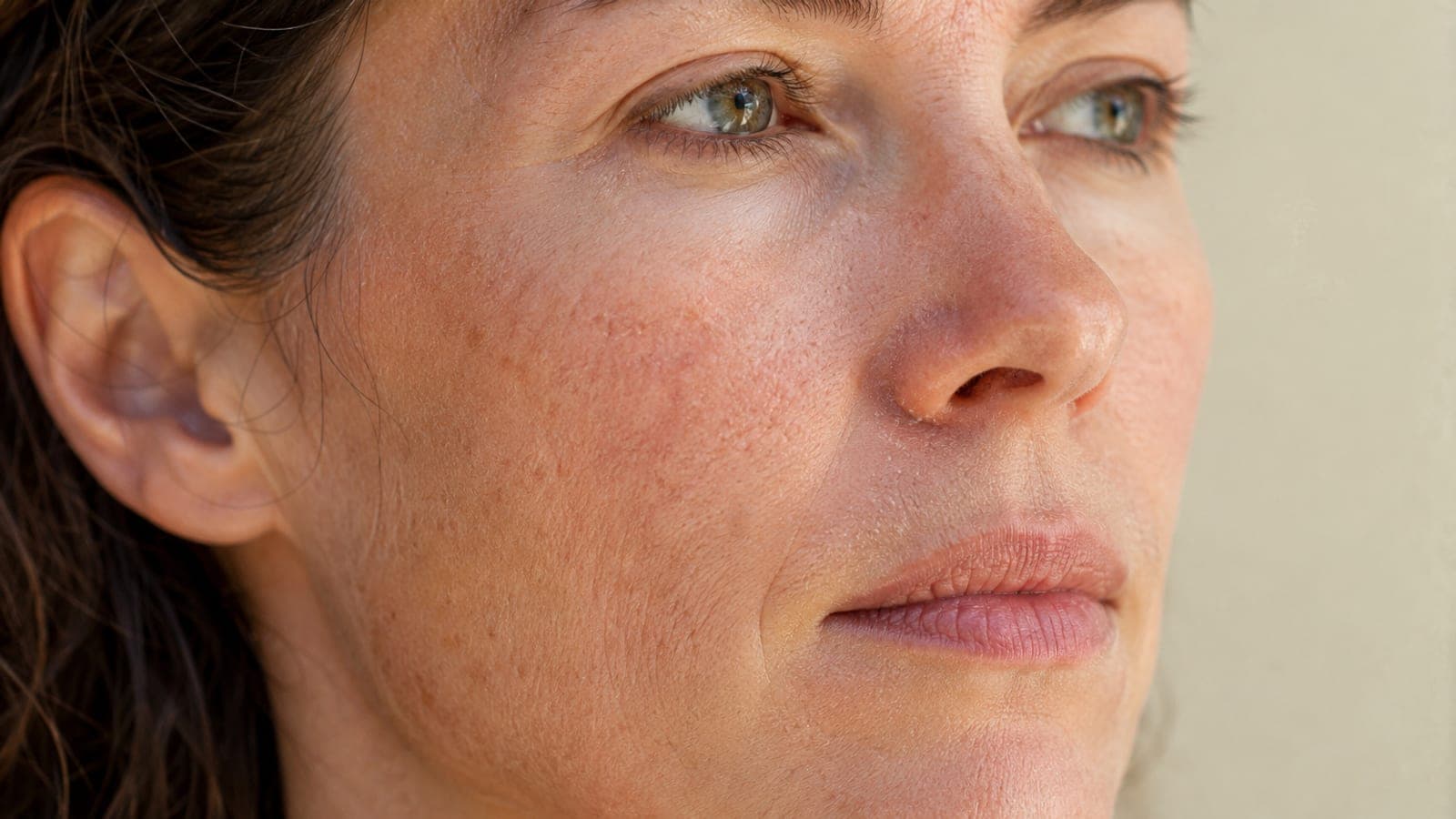
After summer the skin has every right to be dehydrated even with a high SPF, because wind, salt water, chlorine, air conditioning and sun all speed up water loss. Autumn is at the same time the best moment for treatments, because there is less sun. The following sections explain how to give the skin its water back, what to do about pigmentation, how to handle skin that is dehydrated and oily at once, and where acids fit into all this.
Why the skin comes back from holiday in worse shape than you
Even skin protected with a high-SPF filter has every right to be dried out after summer. Everything comes together at once: wind, salt water, a chlorinated pool, air conditioning, dry air and the sun itself.
In such conditions the skin loses water up to four times faster than normal.
Hence the roughness and lack of glow. And hence the impression that cosmetics have suddenly stopped working — because they land on an epidermis that is dried out deeper than an ordinary cream reaches.
Autumn is not a punishment. It is the best moment of the year
Here is the good news that few people think about while putting their flip-flops away.
Most genuinely effective skin treatments require one thing: that the sun stops being a problem. Medical peels, pigmentation therapies, laser treatments — all of them briefly increase the skin's sensitivity to UV radiation. In summer that is a risk. In autumn and winter it is not.
That is why the window from October to March is the most valuable of the whole year in aesthetic medicine. The results show quickly, and the skin has peace in which to regenerate.
In other words: September is not the moment when you give up. It is the moment when you begin.

Step one: give the skin its water back
If hydration cannot be restored with skincare alone after a holiday, we reach for treatments with hyaluronic acid. Two are chosen most often:
- Needle mesotherapy — A cocktail of vitamins, amino acids and hyaluronic acid administered directly into the skin · Nourishment and hydration from within, cells stimulated to regenerate.
- Hydrobalans — Deep hydration with non-cross-linked hyaluronic acid · A quick return of firmness and glow, optimal hydration of the skin.
The clinic, however, is only half the story. The other half happens in your bathroom.
In autumn it is worth switching to strongly moisturising cosmetics — with hyaluronic acid and other humectants, that is, ingredients that bind water in the skin. Add vitamin C to that: it supports regeneration, restores glow and helps in the therapy of pigmentation.
The choice of preparations is best discussed at a consultation, because “moisturising cream” means several dozen different things in practice.
Pigmentation, or the bill presented in September
Whoever let sun protection slide in summer will pay for it in autumn with spots.
They look like small, round or slightly diffuse patches of pigment in various shades of brown. They do not hurt. They appear mainly on the face — on the forehead, cheeks, chin and around the mouth.
The mechanism is simple. UV rays penetrate the epidermis and stimulate the melanocytes, the pigment cells of the skin. Their normal reaction is a tan. But with exposure that is too frequent and too long, some melanocytes become permanently disturbed and start producing too much melanin. The pigment accumulates locally — and that is how a spot forms.
In treating strong pigmentation, medical peels are the most effective. The most powerful tool is depigmentation therapy — a professional lightening course, used also in melasma.
And here honesty is needed, because this is not a “lunch break” treatment.
You have to reckon with a predictable side effect: for at least a week the skin of the face is irritated and peels. Some people have to take that time off work. Afterwards a months-long daily maintenance routine awaits them — without it the effect will not last long.
It is a treatment for the determined. It is worth planning with a calendar in hand.
Skin dried out and oily at the same time? That is not a mistake
The second problem I see in autumn looks like a contradiction: the skin shines, the pores are pronounced, and at the same time it feels tight and rough.
That has nothing to do with teenage acne. It has a lot to do with the sun.
When we sunbathe for days on end, the skin loses water. When hydration becomes critically low, the sebaceous glands get a signal from the body: produce more sebum to shield the epidermis from drying out and damage. The result is that after a holiday the skin can be dried out and oily at the same time.
That is when a treatment using laser light is worth considering. For oily skin with visible pores that also needs brightening and regeneration, what works is a non-ablative Nd:YAG laser in Q-Switch mode. It works in four ways: it stimulates collagen production, exfoliates, curbs the overproduction of sebum and removes pigmentation.
Most patients see a clear improvement after the very first treatment. The treatment is non-invasive — it does not take you out of your life.

Acids, the autumn classic
The most popular autumn treatments are, however, chemical peels, which everyone simply calls acids.
Their role in regeneration is hard to overstate: they rebuild the epidermis by stimulating the basal layer to produce new cells.
Acids used to mean intense peeling and a few days at home. Today a medical peel can also be done for someone who has no way of disappearing from work. Modern preparations are composed individually — it is the selection of ingredients that sets the direction of the therapy and decides the final effect.
Professional treatment lines are created for specific skin needs and selected after a consultation. What they do is resurfacing: intense stimulation of the deeper layers of the skin to renew, which results in a rebuilding of its structure, that is, remodelling. The key point is that the ingredients were chosen so as to minimise the side effects known from traditional peels — modern formulas contain complexes that limit the risk of irritation and inflammation after the treatment, and at the same time improve the penetration of active substances deep into the skin.
Acids do, however, have their rules, and there are no exceptions to them:
- We perform them from October to March, when the sun shines at its gentlest.
- After the treatment an SPF 50+ cream is essential — acids increase the skin's sensitivity to light, and without protection new pigmentation and burns come easily.
What follows from this
Autumn skincare is exceptionally rewarding. The results show quickly, you can afford more effective — though more invasive — therapies and calmly remove what the holidays left behind.
The best moment for a first appointment is September. Not because something is ending. Because that is when the season begins in which the skin can really rebuild itself.
Autumn is also the best moment for treatments that reduce sun-induced pigmentation — you will find a full description of them on the page for laser treatment of pigmentation and erythema.
W naszych klinikach
What we can do about it
Zabiegi
- Laser treatment of pigmentation and rednessLaser treatment of pigmentation and redness is a safe way to even out skin tone and reduce spots, redness and symptoms of rosacea.
- Skin renewal programsSkin renewal programs are our own courses of medical peels, selected after a consultation to suit your skin's needs — anti-aging, brightening or anti-acne.
- Needle MesotherapyNeedle mesotherapy is a “cocktail” of vitamins, amino acids, and hyaluronic acid delivered directly into the skin — it deeply hydrates, revitalizes, and improves firmness and tone.
Nie wiesz, który zabieg będzie właściwy? Cosmetology Consultation — dobierzemy metodę do Twojej skóry.
Last updated: 14 sierpnia 2026