
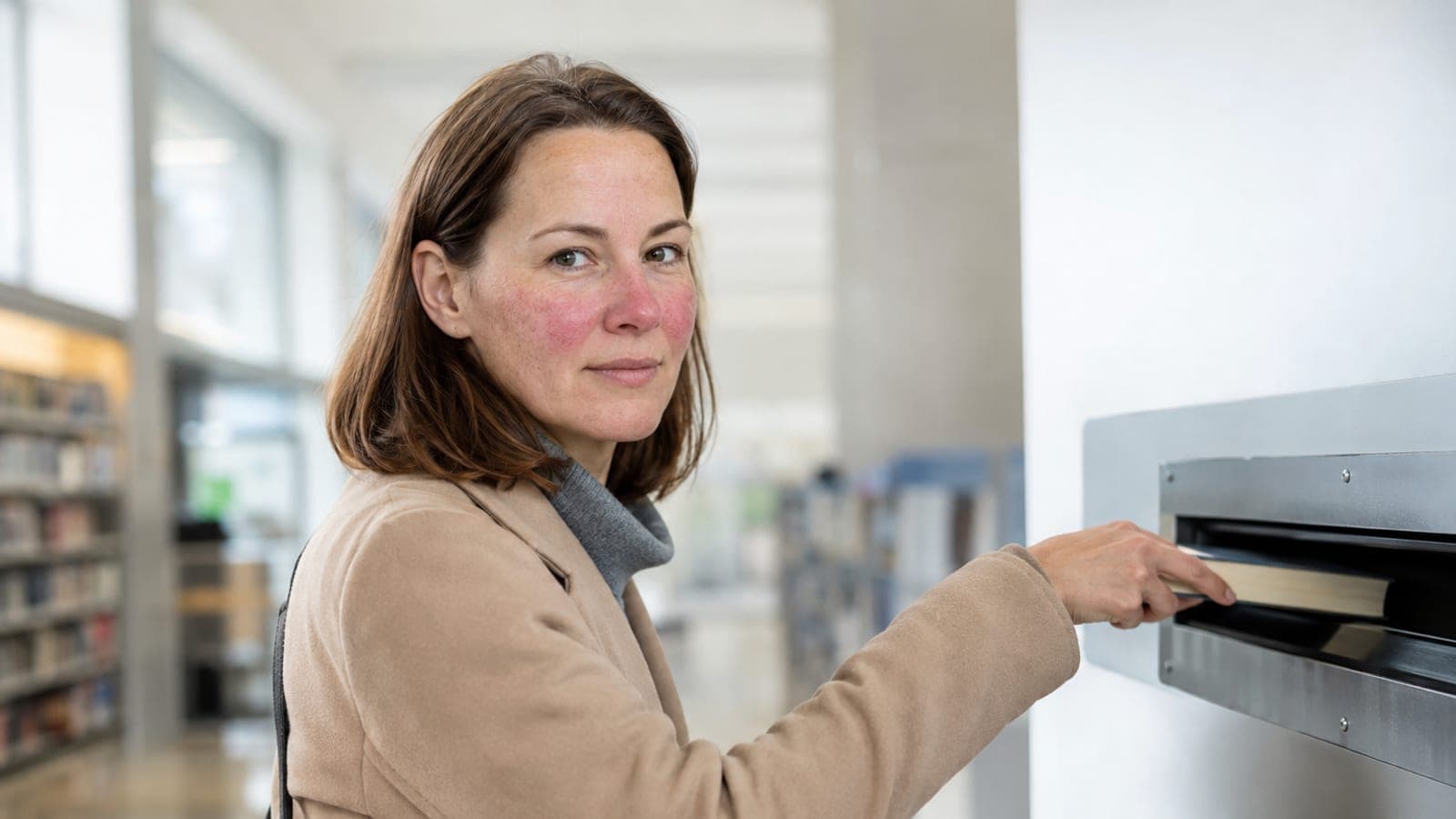
Rosacea is a chronic inflammatory disease of the facial skin whose main symptom is persistent redness. It does not resolve on its own and can become more pronounced year by year, and it is sometimes confused with common acne and with allergy. Below you will find: how to tell rosacea from ordinary facial redness, the four forms of the disease, the factors that aggravate it, and the treatment methods used in the clinic.
"That's just my complexion" — the sentence I hear most often
More and more people come to my office fed up with a permanently reddened face. Patients whose redness does not disappear even under a thick layer of makeup often do not know that they have rosacea (acne rosacea).
It usually starts exactly like this: "My cheeks are red, that's just my complexion".
Only during the interview does the reflection come. That this redness did not appear out of nowhere. That it is becoming more and more pronounced. That it fades less and less often — or does not fade at all any more. And that behind all this lies chronic inflammation of the facial skin.
This awareness is crucial. Because the disease can be treated — you only need to know its cause and know what treatment to start.

Before you decide it is rosacea: redness has many faces
There are plenty of causes of facial redness and most of them are entirely harmless: emotions, heat, alcohol, certain medicines, monosodium glutamate, menopause.
But redness can also be a symptom of systemic diseases. If it comes with other complaints, the possibilities include:
- systemic mastocytosis,
- carcinoid,
- pancreatic tumor.
That is why redness must not be dismissed. It is a symptom you take to a doctor — not to the drugstore. Rosacea is sometimes confused with acne vulgaris and with allergy, and telling these conditions apart is a job for a dermatologist, not for a search engine.
Where rosacea comes from
It is probably a disease with a genetic basis.
If your mother or grandmother always had redness on her face — that is a signal that you may develop it too.
Predisposition alone is usually not enough. The redness appears when the genes are joined by vasomotor disorders, seborrhea, stress, hormonal disorders or the use of certain steroid medications.
At the beginning it is sudden redness, which disappears after a while. The skin reddens around the cheeks and the nose, and redness may also appear on the body.
Over time the redness becomes fixed and the reddening stops receding. This applies especially to people who eat heavy foods and do not avoid alcohol. The situation is made worse still by: using the sauna, smoking cigarettes, cold sores and endocrine disorders.
There is one more element on the list of causes worth knowing about: an abnormal reaction of the skin's innate immunity. In people with rosacea the skin produces an excess of cathelicidin — a defence protein — and of the enzyme that activates it, so that minor stimuli set off an inflammatory reaction. Demodex (Demodex folliculorum) also plays a part: a mite present in everyone, but found in markedly greater numbers in skin with rosacea. That explains why medicines acting on this mite help.
Who gets it
Rosacea affects mainly people between the ages of 25 and 50 and occurs more often in women.
Redness in children most often has no connection with this disease.
Four forms — because rosacea is not one single disease
- Erythematotelangiectatic (erythematotelangiectatic rosacea) — Transient or persistent redness, burning of the skin where the redness is, telangiectasias — that is, "spider veins". Sometimes the face becomes swollen · One of the two most common forms.
- Papulopustular (papulopustular rosacea) — Persistent redness on the cheeks and nose is periodically joined by papules and pustules · Together with the first form, the most common and the easiest to treat.
- With a predominance of hypertrophic changes (phymatous rosacea) — Thickened skin with an uneven surface and nodules — particularly around the nose. The lesions also involve the chin, forehead and ears, and may be accompanied by inflammation of the hair follicles · More often in men.
- Ocular (ocular rosacea) — Recurrent, treatment-resistant inflammation of the conjunctiva, cornea and eyelid margins. Itching and burning of the eyes, a feeling of sand under the eyelids, watering and even photophobia · The hardest to recognize — patients end up not with a dermatologist but with an ophthalmologist.
Besides the forms, successive stages of severity of the disease are also distinguished: from transient redness, through stage I (rosacea erythematosa) and stage II (rosacea papulopustulosa), to stage III (rosacea conglobata).
One reservation about the division above. Since 2017 international experts have been moving away from rigidly assigning a patient to one of the subtypes. The reason is practical: in the same person the symptoms mix and change over time, and what is treated is the specific symptom — redness, papules, hypertrophic changes, eye complaints — and not a label. Nor does it mean that every patient passes in turn through all the stages; in most people the disease never reaches the hypertrophic form.
Each successive stage is more severe. That is why treatment is worth starting before the disease goes further — the sooner the diagnosis is made, the greater the chance of successful therapy.
Let us be clear: this is a chronic disease
There is no point beating about the bush.
Medicines for rosacea, supported by proper skin care and treatments, are very effective. But no method has yet been invented that deals with the redness once and for all.
Rosacea has a tendency to recur. Heavy stress can wake it up. A holiday in a warm country — the face exposed to the sun, the body to cocktails with a paper umbrella — will do the same. What is then needed is prompt medical intervention and a return to the treatment plan.
This is a disease you keep under control, not one you close with a single treatment.

Your most important medicine does not come from a pharmacy
A correct diagnosis is the first thing my patients receive. The second is recommendations on changing their lifestyle — and without them the treatment simply will not work.
Factors that aggravate rosacea:
- Hot spices — Say goodbye to them — they are among the most common triggers of redness.
- Alcohol in large amounts — Cut it down. It is one of the classic factors that make the reddening permanent.
- Heavy foods — Avoid them — they favor the redness becoming fixed.
- Sauna — Sauna fans have to find another way to relax.
- Sudden changes of temperature — Avoid going from the frost into overheated interiors.
- Sun — The basis of treatment: correctly used UV filters, a hat, limiting time spent in the sun.
- Stress — Excess stress aggravates the redness — this is not "soft" advice, but part of the therapy.
- Cigarettes — Smoking worsens the course of the disease.
- Cold sores, endocrine disorders — They require treatment — they make the skin worse.
If I had to point to one item on this list, it would be sun protection. Without it, even the best-chosen treatment loses part of its effectiveness.
Topical treatment — on a doctor's prescription, not off the shelf
An important caveat here: treatment for rosacea is chosen by the doctor after making the diagnosis. Buying "something for red cheeks" on your own can be costly in its consequences — strong peels and brightening products can aggravate the disease instead of calming it.
Topical treatment uses creams and ointments with metronidazole. It can help to use topical antibiotic therapy and products with azelaic acid. What to use and when is decided by the doctor.
Topical treatment also includes ivermectin cream — in comparative studies it performs more effectively than metronidazole, especially with papulopustular lesions. A separate group are products acting directly on the redness: brimonidine and oxymetazoline constrict the vessels and reduce the reddening for several to more than ten hours. They do not cure the disease, and in some people the redness comes back stronger than before once they are stopped — which is why the decision to start them is made by the doctor.
Daily skin care is a separate matter. I recommend to my patients:
- washing the face with gentle, detergent-free products,
- facial cosmetics with vitamin C, which strengthens the blood vessels.
What we can do at the clinic
To calm redness on the face and body faster and more effectively, we reach for aesthetic medicine treatments. They do not replace the treatment — they complement it.
What we do in our clinics:
- Peels with azelaic acid — Controlled, medical exfoliation that calms the skin · The mildest form of the disease — that is where they give good results.
- Laser treatment of discoloration and redness (light therapy) — Light with a wavelength of 500–600 nm penetrates the vessels, and the energy of the beam is absorbed by hemoglobin — the pigment of the red blood cells. The temperature rises and the heat passes from the blood cells to the wall of the vessel — it is damage to that wall which closes the vessel permanently. Safety is decided here not only by the wavelength but also by the pulse duration matched to the diameter of the vessel · Reduction of redness and closing of fine vessels.
- Laser closing of vessels (Nd:YAG 1064 nm laser) — The laser beam causes the vessel to close · Larger, visible blood vessels. With the same handpiece we also close vessels on the legs.
- Complete — redness reduction — An original, multi-stage procedure of the Dr Kuschill MEDESTETIS clinics for vascular skin · People with persistent redness who need an organized plan rather than a single treatment.
What actually happens to the vessel
Coagulation is a natural, irreversible reaction of proteins to a rise in temperature.
As a result, the blood vessel is closed and then, over about 4 weeks, undergoes resorption — it is absorbed and ceases to be visible.
Closing vessels with a laser is quick, safe and very effective, which gives these technologies a clear advantage over older methods.
How long it takes
Laser treatments are performed in a series, and I set its length with each patient individually.
The intervals between visits are 4 weeks. Typically we plan a series of three to five treatments at intervals of four to six weeks; in most patients the redness then clearly decreases, although the scale of the improvement varies.
What to expect after the laser treatment itself: immediately afterwards the skin is red and slightly swollen, and after a dye laser a temporary bluish discolouration may appear, which fades over several days to a couple of weeks. Throughout the whole series consistent sun protection applies — tanned skin is a contraindication to the next session. And the most important thing: the treatments reduce the redness, but they do not cure the disease, so once the series is finished maintenance visits are usually needed.
Finally: this is not a matter of looks
If for years you have been told that you simply "have that kind of complexion", it is worth naming it plainly.
Rosacea is a chronic disease — with a cause, a course, stages and treatment. It is not a cosmetic flaw and it is not your fault. It will not disappear thanks to a good cream or a stronger peel.
But the symptoms can be controlled. The redness can be significantly reduced and the periods of calm made longer. On two conditions: that the diagnosis is made by a doctor and that you turn the list of aggravating factors into your daily instruction manual.
The first step is showing your skin to a dermatologist. The assessment takes about a quarter of an hour, and it is immediately clear what we are dealing with and what makes sense in your case.
W naszych klinikach
What we can do about it
Zabiegi
- Complete – Redness ReductionComplete is MEDESTETIS's signature multi-stage redness reduction procedure for vascular skin that calms redness, strengthens the skin barrier and improves comfort by combining laser therapy, tropocollagen and LED phototherapy.
- Laser treatment of pigmentation and rednessLaser treatment of pigmentation and redness is a safe way to even out skin tone and reduce spots, redness and symptoms of rosacea.
Nie wiesz, który zabieg będzie właściwy? Dermatology consultation — dobierzemy metodę do Twojej skóry.
Sources
- Interventions for rosacea — PubMed.
- The efficacy, safety, and tolerability of ivermectin compared with current topical treatments for the inflammatory lesions of rosacea: a network meta-analysis — PMC.
- Standard classification and pathophysiology of rosacea: The 2017 update by the National Rosacea Society Expert Committee — PubMed.
- Meta-Analysis of the Efficacy of Intense Pulsed Light and Pulsed-Dye Laser Therapy in the Management of Rosacea — PMC.
- Rosacea treatment: How to treat the redness — AAD.
Last updated: 14 sierpnia 2026