
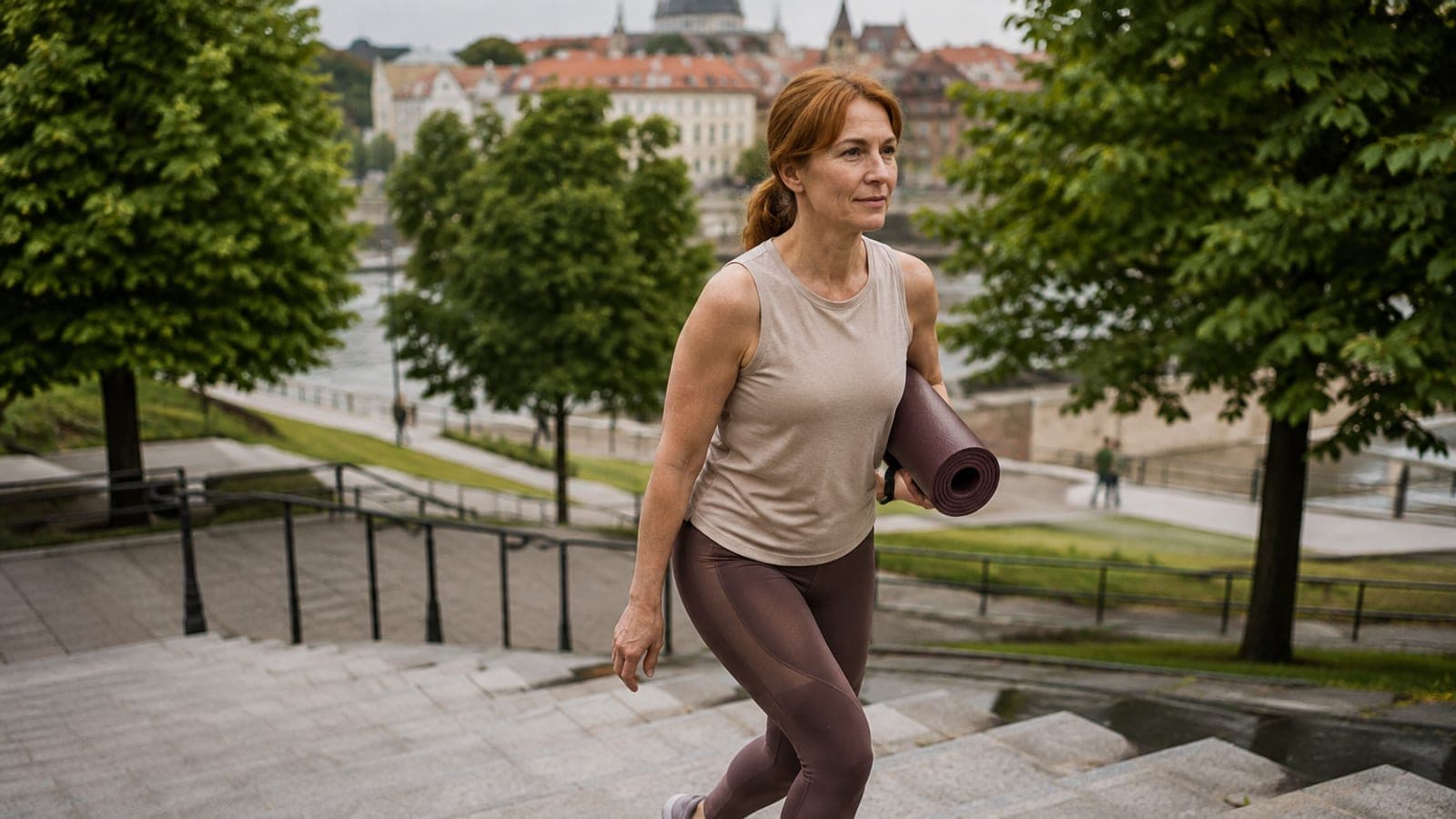
Skin firmness depends on collagen and elastin, and their production slows down around your twentieth birthday, not after forty. That is why laxity is not a problem of one age group: it affects skin after major weight loss just as much as the eye area of someone in their thirties. The process is natural, but it can be slowed. Further on: how a stomach after weight loss differs from a stomach after pregnancy, which energy-based and injectable treatments are used on the face, what works on thighs, stomach and buttocks, and a summary of which treatment suits what.
Why skin stops holding its shape
Two proteins are responsible for firmness and elasticity: collagen and elastin.
Teenagers naturally have plenty of them, which is why their skin looks the way it does. The problem is that the production of these proteins slows down as early as around your twentieth birthday. Not after forty. After twenty.
It shows first around the eyes. The epidermis there is exceptionally thin and the mimic muscles exceptionally strong — the effect of their daily work is quickly recorded in the form of under-eye wrinkles and crow's feet.
This is a completely natural process. The good news is that it can be slowed down.

An abdomen after weight loss and an abdomen after pregnancy are two different stories
Sagging skin on the thighs or abdomen most often affects patients who have changed their lifestyle and lost a lot of weight in a short time.
The body has shed the excess fat tissue — but the skin was not given time to adapt to the new body shape. Hence the disappointment after months of well-done work.
The second group is women after pregnancy. Even the fit and active ones. If the skin was not properly oiled and moisturized during pregnancy, the part that can be especially stubborn is the lower abdominal fold.
What you can avoid now so there is nothing to repair later
If you do not yet see a loss of skin density in yourself — this is the best moment to take care of prevention. It is remarkably simple:
- moisturizing eye creams,
- consistent sun protection,
- physical activity that keeps your muscles and skin in good condition.
That is it. No magic. But some changes cannot be avoided anyway — and that is when the conversation about treatments begins.
What aesthetic medicine can do today
Technologies change, devices are refined, and research into new methods of stimulating collagen production continues without a break. In practice this means one thing: there is no single treatment for sagging skin, there are more than a dozen, and the choice depends on where the problem occurs and how advanced it is.
Below is a short overview — the face first, then the body.
Microneedle radiofrequency — spectacular and with no recovery time
Very thin needles inserted under the skin emit radio waves. This produces a controlled overheating of the tissue, and in overheated tissue the body immediately launches a repair process.
The first effects are visible after a few weeks, but the remodelling of collagen is spread over months — the full result is usually assessed after three to six months. A series of 3–4 treatments is the standard; a single treatment is rarely enough, and the effect needs maintaining.
The laser that leaves no sign you have been to a doctor
The non-ablative Nd:YAG laser in Q-Switch mode is a non-invasive lift that deals with wrinkles and laxity at the same time. It tightens the skin and stimulates it to produce collagen.
It does not damage the epidermis, so it requires no recovery time. The results are natural, and that is why the treatment is liked not only by women but also by men who want to look younger without visible signs of intervention.
A bonus worth knowing about: along the way it reduces discoloration and shrinks pores. On oilier skin this gives really good results.
Injections: when the skin needs material delivered to it
Needle treatments work differently from devices. They do not heat and do not tighten — they deliver a specific building material to the skin, or a signal to get to work.
Needle mesotherapy
With a microneedle I administer hyaluronic acid, which moisturizes the skin and restores its density, and calcium hydroxyapatite, which stimulates collagen formation.
This is an option for patients who want three things at once: deep hydration, radiance and firmness, and along the way the replenishment of any volume loss in the facial contour.
Mesotherapy with type I collagen
The second variety of needle mesotherapy uses type I atelocollagen — a collagen that stimulates the body to produce its own.
After the treatment the skin regains firmness, is better tightened and denser, and any deficits are filled in.
Platelet-rich plasma, or the so-called vampire lift
The material here is the patient's own blood. We centrifuge it and obtain plasma with a very high concentration of platelets.
Platelets contain a high concentration of active substances — natural growth factors involved in the repair and remodeling of tissue. Because the plasma is biocompatible, the body does not treat it as a foreign body.
What happens after the treatment:
- after the very first session the skin is smoothed and regains an even, healthy tone,
- its firmness and elasticity improve,
- the stimulated fibroblasts start producing collagen, so after a few weeks the skin becomes noticeably denser.
One note about the evidence. Platelet-rich plasma has an advantage over control treatments confirmed in randomised trials — in the assessment of patients as well as of doctors — but the effect is moderate, not spectacular. The studies are also small and differ in the way the plasma is prepared, so results from one clinic do not translate directly to another. Safety is good: the frequency of adverse effects did not differ significantly from the control groups.
Plasma also works excellently as a complement to mesotherapy.
PDO and PLLA threads
A treatment particularly recommended for women over the age of 40, who show signs of reduced collagen production.
The threads immediately firm the skin of the face and at the same time stimulate the production of collagen and elastin. They are fully dissolvable, they require no incisions, and the treatment can be repeated if needed.
Threads are an invasive treatment and it has to be said honestly what can be expected of them apart from the result. The most common thing is swelling — it affects roughly one third of patients. Less often there are dimples in the skin, temporary numbness of the area or a thread you can feel under the skin; then we come back to the treatment room. Satisfaction with the result is highest right after the treatment and after six months it is usually already somewhat lower, which is why threads are planned as part of a longer strategy and not as a one-off solution.
And what about thighs, abdomen and buttocks
Here is the good news: every one of the treatments described above works just as well on the body. The skin of the thighs or abdomen responds to the same stimuli as the skin of the face.
There are, however, two methods designed specifically for the body.
Endermologie
A special head simultaneously massages and suctions the tissue. It uses electronically controlled rollers and a vacuum effect, which together act on all layers of the skin.
The effect comes primarily from improved circulation and drainage: the skin becomes firmer and smoother to the touch, and in studies body circumferences went down by an average of nearly three centimetres per area. On cellulite itself the method acts gently — it improves its appearance but does not remove it.
Shockwave therapy
The treatment uses an acoustic wave, that is, a mechanical wave of high pressure and very short duration. This is not an electric current and it does not replace the work of the muscles. The energy penetrates deep into the tissue, and the impulses produce vibrations that cause alternating mechanical stretching and relaxation of the connective tissue.
The list of effects is long:
On the body the arithmetic is different from the face. Shockwave treatments and endermology are always a series — in clinical trials usually six to eight sessions performed once or twice a week, not single visits. Nor is there reliable data on what happens to the effect after a year has passed, so you have to assume it will need maintaining. If after a large weight loss the excess skin is considerable, none of these treatments will remove it — the conversation then concerns surgery, not aesthetic medicine.
- rebuilding and densification of collagen and the formation of new capillaries,
- firming of sagging skin,
- increased firmness and elasticity,
- improved microcirculation and metabolism in the treated area,
- improvement of the microcirculation in the skin,
Which treatment for what — a summary
- Microneedle radiofrequency — Thin needles emit radio waves, controlled overheating triggers repair · Face, body · First effects after a few weeks, the full result after a few months; a series of 3–4 treatments.
- Nd:YAG laser (Q-Switch) — Non-ablative lift without damaging the epidermis · Face — especially oilier skin and skin with discoloration · Gradually, with no recovery time.
- Needle mesotherapy — Hyaluronic acid moisturizes, calcium hydroxyapatite builds collagen · Face, neck, décolletage · Gradually.
- Mesotherapy with type I collagen — Atelocollagen stimulates the production of the body's own collagen · Face, areas needing densification · Gradually.
- Platelet-rich plasma (PRP) — Growth factors from your own blood activate fibroblasts · Face, body · Tone after the 1st treatment, density after a few weeks.
- PDO / PLLA threads — They tighten mechanically and stimulate collagen and elastin · Face — patients over the age of 40 · Firming immediately.
- Endermologie — Massage with tissue suction, rollers and vacuum · Thighs, abdomen, buttocks · Gradually, in a series.

Finally: the clinic is not everything
Even the best treatment cannot stand on its own. The treatment is always complemented by what you do between visits:
- more movement,
- getting enough sleep,
- reducing stress as far as possible,
- a diet rich in fruit, vegetables, whole grains and plenty of water.
These are not empty tips. They are literally the recipe for extending the durability of the results you have paid for.
And one more thing, because it is the most common question in the office: sagging skin does not mean it is too late. It only means the skin has stopped keeping up — and that can be made up for at any age. All it takes is matching the method to the problem, not to the age on your ID.
To rebuild firmness from within we use tissue stimulators — a group of products that stimulate the skin to produce its own collagen. The type of stimulator is selected by the doctor.
W naszych klinikach
What we can do about it
Zabiegi
- Tissue stimulatorsTissue stimulators are injectable products based on hyaluronic acid or polynucleotides that prompt the skin to produce its own collagen and elastin — improving hydration, firmness and overall skin quality rather than filling wrinkles.
- PDO Threads – Skin Lifting and BiorevitalizationPDO threads (polydioxanone) tighten and lift the skin while stimulating collagen production — a lifting without a scalpel with an effect visible right away and building over time.
- Fractional Microneedling RadiofrequencyFractional microneedling radiofrequency combines microneedling with radio waves, firming the skin and reducing wrinkles, scars and stretch marks.
Nie wiesz, który zabieg będzie właściwy? Aesthetic medicine consultation — dobierzemy metodę do Twojej skóry.
Sources
- Facial skin tightening with an 1100-1800 nm infrared device — PubMed.
- Long-term evaluation of collagen and elastin following infrared (1100 to 1800 nm) irradiation — PubMed.
- The Landscape of Radiofrequency Technology for Skin Rejuvenation — PMC.
- A Meta-Analysis and Systematic Review of the Incidences of Complications Following Facial Thread-Lifting — PubMed.
- Meta-Analysis of the Efficacy of Platelet-Rich Plasma in Treating Skin Aging — PMC.
Last updated: 28 sierpnia 2026