
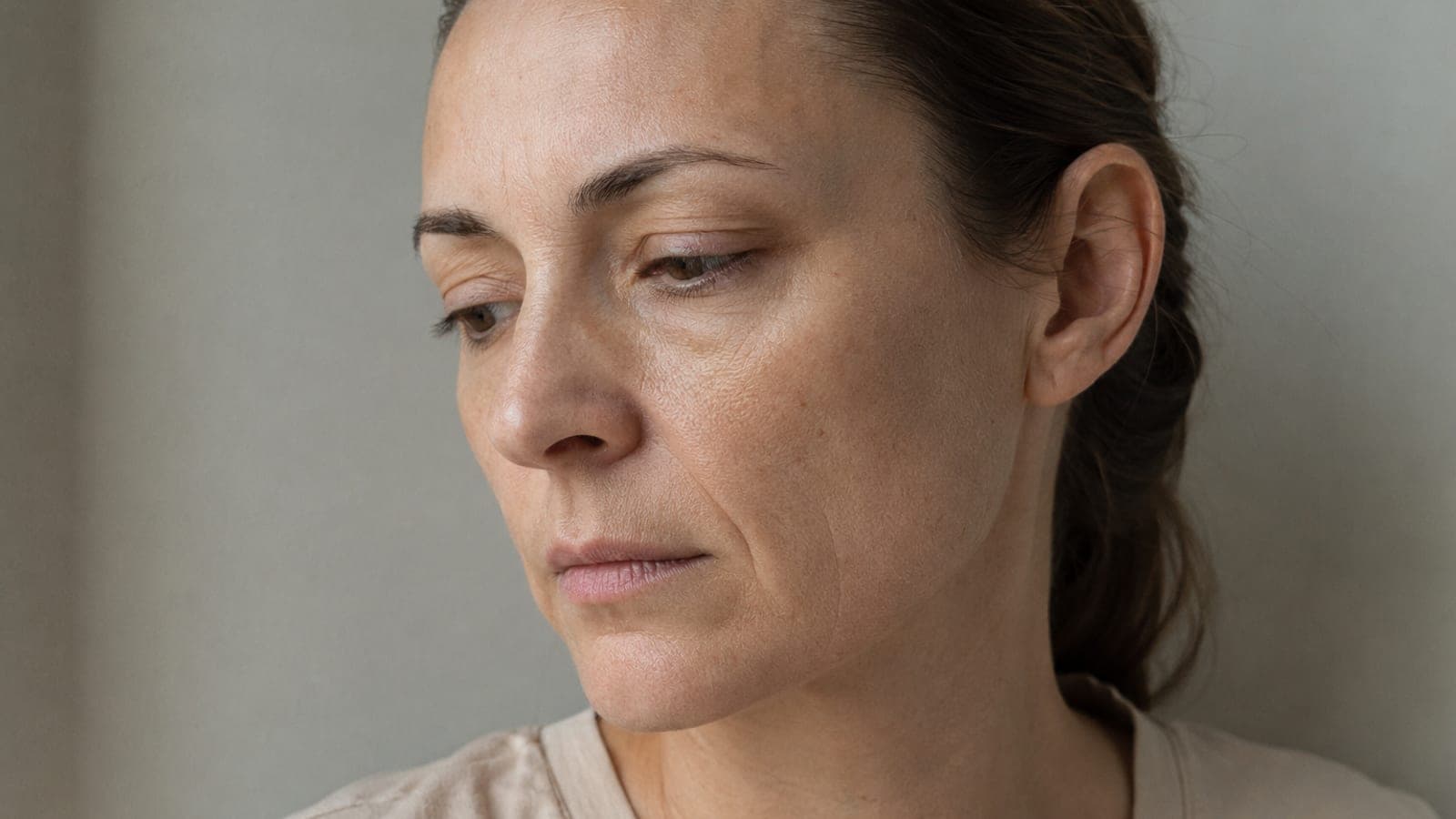
A grey skin tone, fine vertical lines above the upper lip and a somewhat sunken complexion make up a set of signs distinctive enough to have earned its own name: smoker’s face. Toxins from smoke pass from the lungs into the blood and reach the skin. This text is not about smoking being harmful, but about what exactly smoke does to the skin, what changes after quitting, what quitting alone will not undo and why treatments work less well in someone who smokes.

What smoke does to the skin
Most is said about the lungs. But the toxins pass from the lungs into the blood, and the blood distributes them around the whole body.
Cigarette smoke contains numerous hydrophobic substances. They pass easily through cell membranes and reach almost every organ.
There are also free radicals — these destroy every cell they come into contact with. Skin cells too.
They damage keratinocytes and fibroblasts and impair the synthesis of collagen and elastin. To put it simply: they dismantle the scaffolding of the skin and weaken its ability to regenerate.
The effect is visible in the mirror. The skin becomes thinner, as if sunken, and around the mouth and above the upper lip you get smoker's lines.
That is not all.
Inflammation. An imbalance between free radicals and antioxidants sets off a range of inflammatory states in the body. On the skin this shows above all as faster photoageing, the breakdown of collagen and poorer healing. The popular notion of smoker's acne, on the other hand, is contested — studies do not confirm a link between smoking and the severity of acne.
Hormones. Smoking lowers the level of active oestrogens — not by inhibiting their production, but because components of the smoke speed up the breakdown of oestradiol into inactive forms. Nicotine itself, from a patch for instance, does not act here the way smoke does. In women the effects are clearly visible, because they resemble the symptoms of the menopause: a loss of firmness and severe drying of the skin.
Circulation. The blood vessels constrict, the blood circulates more slowly, the skin is not properly oxygenated. Hence that characteristic grey, sallow tone.
Nails. Tarry substances from the smoke penetrate the nail plate and give it a yellowish, sometimes orange or brown tone.
One cigarette, and the domino effect spreads through the whole body.
What happens when you stub out the last one
Researchers at the American Cancer Society examined precisely what happens in the body after giving up smoking. The improvement is visible almost immediately:
- After 20 minutes the pulse and blood pressure begin to normalise.
- Within the first 24 hours the concentration of nicotine in the blood drops to zero.
- At the same time the body gets rid of carbon monoxide — the gas in the smoke that blocks haemoglobin — and the cleansing of the lungs begins. A day later you taste and smell better.
For the skin you have to wait longer — at least a month. First you will notice that it is better hydrated and oxygenated. Then the tone gradually improves and the glow returns. If you keep going for further months, the improvement in tone, hydration and firmness becomes visible to the naked eye.
What giving up alone will not reverse
Not every trace disappears.
The face before the first cigarette and the face after giving up will never look the same. Not only because the nicotine has left changes behind — also because in that time the skin was simply ageing.
Nature is helpless here. Aesthetic medicine is not.
Why treatments work less well in a smoker
This matters before we get to specifics.
There is no therapy that would cancel out the influence of everyday smoking on the skin. In people who smoke, even the best rejuvenating treatments give weaker results.
Some treatments are in fact inadvisable. Nicotine means that wounds on the skin heal more slowly — and skin that cannot regenerate effectively after being punctured or heated will not respond to therapy the way it should.
That is why the order matters: cigarettes first, the clinic afterwards. The other way round simply does not pay.
If you already have that behind you — the specifics are below.
If you are planning a treatment with needling, a laser or a surgical procedure, it is worth knowing a specific number: four weeks. That is the minimum without a cigarette needed for the risk of healing complications to fall appreciably — in people who smoke the risk of necrosis of the wound edges is several times higher than in non-smokers. The point is not to stop on the day of the treatment, but to stop a month earlier and not go back afterwards.

Step 1: cleansing and a dose of antioxidants
To begin with I usually propose a medical peel with vitamin C. It is suitable for every skin type.
The therapeutic foundation here is vitamin C — in the form of ascorbyl tetraisopalmitate [4%] and L-ascorbic acid [15%] combined with ferulic acid [1%]. Vitamin C has antioxidant properties in its own right.
What it gives: brightening of the skin, evening out of the tone, improved texture.
The treatment takes about 45 minutes. Immediately afterwards the face may be slightly reddened, but the skin should not peel.
The treatment in the clinic is a quarter of the work. The rest happens at home: vitamin C in the morning and a high-protection sunscreen all year round. That is not a cosmetic extra — in people who smoke and are at the same time heavily exposed to the sun, the risk of wrinkles is many times higher than in people affected by only one of these factors. Smoke and sun do not add up, they amplify each other.
Step 2: revitalisation, or rebuilding from within
Here the choice depends mainly on one thing: whether you accept needles.
Needle mesotherapy
The most popular treatment stimulating the skin's natural rebuilding processes. A suitably selected cocktail of nutrients and vitamins regenerates and brightens dry, sallow skin. The doctor introduces it into the deep layers of the skin with a series of punctures.
No need to worry — the needle is very thin, and the pricks resemble a mosquito bite. After the treatment swelling may last a few days. Sometimes bruises appear, which heal in about 7 days. The full effects are visible after a series of 3–6 treatments.
The skin is nourished by making up deficiencies of vitamins and minerals. Mesotherapy also supports microcirculation and stimulates the cells to produce new collagen fibres — the skin gains firmness and elasticity. The treatment strengthens the epidermis, which reduces the shadows under the eyes. The complexion is brightened and visibly rejuvenated.
Platelet-rich plasma
Also known as the vampire lift.
The growth factors released from the platelets are responsible for the division and multiplication of stem cells. These in turn stimulate the tissues to regenerate, and can themselves transform into new, healthy tissue. In the skin they stimulate the production of new epidermal cells, renewal processes and the formation of new collagen fibres and blood vessels.
Regeneration without the risk of a reaction to foreign material — plasma is one of the most natural materials we use in aesthetic medicine. As with any injection, swelling and small bruises occur. It is simply your own blood.
How it looks: first a blood sample is taken from a vein in the crook of the elbow. Then the tubes go into a centrifuge, which separates the red and white blood cells from the plasma containing the platelets. The ready plasma is injected with very fine needles — point by point or in lines, along the wrinkles.
For the full results you have to wait until the collagen fibres, the “scaffolding” of the skin, have been rebuilt. That takes from three to six weeks.
Honestly about the evidence: studies on plasma show an improvement in collagen density and high patient satisfaction, but they differ greatly among themselves — because the ways of preparing the plasma differ. The same treatment carried out with two different kits is in practice two different preparations. So ask which system the clinic uses, and do not compare prices without that information.
3-in-1 revitalisation GeneO® — for those who are not keen on needles
The treatment oxygenates the skin, exfoliates dead, keratinised epidermis and at the same time makes it easier for revitalising substances to be absorbed. It is a little like a massage — it is performed with a special head.
Next the face is covered with a gel whose action is rejuvenating or brightening and nourishing. The gel combines with a capsule based on sodium bicarbonate and citric acid. An ordinary acid-base reaction takes place, producing a mass of carbon dioxide bubbles — these give the characteristic fizzing sensation on the skin. The manufacturer explains the action of the treatment by the Bohr effect, the physiological phenomenon whereby an increase in the concentration of carbon dioxide makes it easier for haemoglobin to release oxygen to the tissues.
The microgranules escaping from the capsule immediately exfoliate the horny layer of the epidermis and remove accumulated impurities. Skin prepared in this way absorbs the active substances from the gel in a flash — among others azelaic, kojic and hyaluronic acid.
The skin looks young, fresh and radiant straight after the treatment, and the effects last about 3 months.
Three routes to revitalisation — a comparison
- What we administer — A cocktail of vitamins and nutrients · Your own blood after centrifuging · A gel with active substances, without puncturing.
- Needles — Yes, a very fine needle · Yes, plus a blood sample from a vein · No.
- When the effect comes — In full after a series of 3–6 treatments · 3–6 weeks, once the collagen has been rebuilt · Immediately, lasting about 3 months.
- After the treatment — Possible swelling for a few days, sometimes bruises (about 7 days) · Point marks after the injections · No downtime.
- Best for — Dry, sallow skin with deficiencies · Skin needing deep rebuilding · A grey, tired epidermis and a dislike of needles.
Step 3: wrinkles around the mouth — cause and effect separately
With deep wrinkles I use two treatments in parallel: an injection of botulinum toxin and filling with hyaluronic acid.
They are not the same thing and do not replace each other:
- Botulinum toxin relaxes the muscles, so that the wrinkles do not deepen further — it acts on the cause.
- Hyaluronic acid fills a wrinkle that already exists, leaving smooth, younger-looking skin — it acts on the effect.
Both treatments are quick, minimally invasive and practically painless. For very sensitive patients I apply an anaesthetic cream beforehand.
The effects are best seen after a week — when the filler has settled where it was administered and the botulinum toxin has blocked the transmission between the nerve cells and the muscle cells.
Step 4: when the skin has lost its firmness
If the loss of firmness and elasticity is considerable, device-based treatments enter the therapy plan. Their possibilities are broad and the effects can be spectacular.
The choice depends on the condition of the skin, on sensitivity and on the patient's preferences.
What we do in our clinics:
- Fractional microneedling — A head with a system of pulsating needles stimulates the skin to use its natural capacity for regeneration. Automatic puncturing increases the penetration of active ingredients and reduces discomfort · Visibly firmer, rejuvenated skin. The best results come from a series of 3–6 treatments every 2–4 weeks.
- Microneedle radiofrequency — The head simultaneously punctures the skin with very fine needles and emits a radio wave that heats the tissue around them. This stimulates the skin to renew itself and to produce collagen · A treatment under local anaesthesia, lasting about 30 minutes. The effects are best seen after 4–6 weeks; individual papers show the improvement maintained after a year, but there is little data from longer observation.
What can realistically be improved, and what cannot
Honestly, without promising miracles.
What can be improved: the tone and greyness of the complexion, hydration, the density and firmness of the skin, the depth of the wrinkles around the mouth, the overall quality and smoothness of the surface. With a well-chosen series of treatments the difference can be really large.
What cannot: turning back time. The skin will not return to its state before the first cigarette, because over those years it was simply ageing. That is not a failure of the therapy — it is arithmetic.
The condition without which the rest will not work: no cigarettes. Not for moral reasons but biological ones — nicotine slows healing and constricts the vessels, so every treatment carried out “in the meantime” will give a weaker result and wear off sooner.
You have to take the first step yourself. But you do not have to take it alone.
Draw on the support of people who have this stage behind them — nobody will understand you the way they do. Or on the help of a psychologist. A doctor can also propose pharmacological support; no medicine has as many side effects as smoking cigarettes. There are also unconventional methods: acupuncture, acupressure, bioresonance, hypnosis, homeopathy.
The method is secondary. What counts is the result.
The Polish songwriter Agnieszka Osiecka put it beautifully: wracaj w deszcz, proszki bierz, tylko nie pal!
We support the rebuilding of hydration and skin quality with treatments such as Hydrobalans or tissue stimulators — the choice depends on the condition of the skin, which the doctor will assess.
W naszych klinikach
What we can do about it
Zabiegi
- Needle MesotherapyNeedle mesotherapy is a “cocktail” of vitamins, amino acids, and hyaluronic acid delivered directly into the skin — it deeply hydrates, revitalizes, and improves firmness and tone.
- Skin Revitalization 3-in-1 GeneO®Skin Revitalization 3-in-1 GeneO® combines exfoliation, oxygenation and delivery of active ingredients — it moisturizes, brightens and refreshes the skin immediately.
- Tissue stimulatorsTissue stimulators are injectable products based on hyaluronic acid or polynucleotides that prompt the skin to produce its own collagen and elastin — improving hydration, firmness and overall skin quality rather than filling wrinkles.
Nie wiesz, który zabieg będzie właściwy? Aesthetic medicine consultation — dobierzemy metodę do Twojej skóry.
Sources
- Skin aging induced by ultraviolet exposure and tobacco smoking: evidence from epidemiological and molecular studies — PubMed.
- Dermatological Manifestations of Smoking-Induced Oxidative Stress and Inflammation: A Multifaceted Analysis of Cutaneous Aging and Disease Progression — PMC.
- Health Benefits of Quitting Smoking Over Time — American Cancer Society.
- Wound healing and infection in surgery. The clinical impact of smoking and smoking cessation: a systematic review and meta-analysis — NCBI Bookshelf.
- Improvement in skin color achieved by smoking cessation — PubMed.
Last updated: 28 sierpnia 2026